Delilah Montoya showed us a virtual tour of her show Chicana bad girls, which was a collection of 18 different artists, somehow showing empowerment and courage in women. She had hoped to inspire and show people the strength of Chicana women, and their true “bad girl” side. She wanted people to see that being a bad girl wasn’t necessarily a negative thing. It was a way of empowering ones self, and standing up for yourself and what you believe it.
The only piece of work that I clearly remember was the very first piece she showed us of an interpretive dance around tree of life. The costumes of the dancers resembled Adam and Eve. I wish I would have been able to see the actual dance, it seemed very provocative, but respectable at the same time, and ended with the forbidden fruit being eaten.
There was one artist that stood out to me by Paula Lopez. She was a colorist who never went to art school. I thought it was inspiring that she became a famous artist without any schooling. She opened her own art store, and would become familiar with the supplies on her own, and would then ask customers who were also artists. There was one picture where she was remembering a time as a child. Her teacher would always criticize her work and tell her to paint in another color other than red. But she refused to do so and still became a famous artist. A lot of her work stood out to me because of the bright vibrant colors that she used, it was hard not to look at it, and see the way she mixed colors and contrasted them. I also really liked the one artist who paid her way through school by stripping, who mixed self portraits with cartoons.
I was honestly dreading going to one of these talks so I had to go to hers because it was the last one, and unfortunately I procrastinated. I thought this talk would be pretty interesting. It’s always good to see women photographers who have made a name for themselves. But going in I was expecting to see some of her work. I’m not a very “artsy” person, but I enjoy looking at photographs because it’s something I like doing, and being in photography this semester I could have connected with some of her work. Needless to say I was a little bit disappointed in the fact that I didn’t get to see any of her work. I really didn’t like any of the other work that she showed, but I feel like if it were presented better I would have taken more of an interest in it. I wish she would have thrown some of her own work into the mix as well.
Monday, May 11, 2009

War Photographer
Overall, War Photographer is a really well-made and extremely provocative look at James Nachtwey's life as a photojournalist. Christian Frei's decisions concerning camera placement--especially mounted onto Nachtwey's camera--really puts the audience into Nachtwey's eyes as he documents the horrors of war. The fact that the film documents Nachtwey's documentation is an interesting sort of meta-documentation that reminds me of Ken Josephson's photograph of a photograph.
Something that did trouble me about the film's production is how long the film takes to tell the audience that Nachtwey actually has the permission of his subjects before he photographs them. In the scenes before that, these horribly downtrodden people are crying and often staring straight into the camera. Without knowledge that Nachtwey has their permission, I thought he was an unimaginable asshole getting in grieving people's faces. That's probably intentional, but I didn't care for that.
Other than that, the film is filled with memorable images, especially the family living on the gravel between train tracks. I'll never forget how little disturbed they are by the trains speeding past them as they eat and go about their day.
Something that did trouble me about the film's production is how long the film takes to tell the audience that Nachtwey actually has the permission of his subjects before he photographs them. In the scenes before that, these horribly downtrodden people are crying and often staring straight into the camera. Without knowledge that Nachtwey has their permission, I thought he was an unimaginable asshole getting in grieving people's faces. That's probably intentional, but I didn't care for that.
Other than that, the film is filled with memorable images, especially the family living on the gravel between train tracks. I'll never forget how little disturbed they are by the trains speeding past them as they eat and go about their day.
Thursday, May 7, 2009
Art Event: SMP presentations (round 1)
Apparently I keep forgetting to do this, so here it is... at the last possible minute!
About two weeks ago, I went to the Studio Art SMP presentations, put on by Mike Benjamin, Sarah Kramer, and Anne Rowan. I was incredibly inspired by all three of the presenters. They are truly amazing artists and presented their art in interesting and engaging ways.
Mike Benjamin is a close friend of mine, so I knew a bit about his work before the presentation. I especially loved hearing about the details of the project. It's clear how much time and effort he's put into this proposal, and I truly hope he finds success! I thought it was especially great how interactive and informal his presentation was. He engaged with the audience and really encouraged people to speak their minds. I also loved his writing in the little "pamphlet."
Sarah Kramer's work really caught my eye. I loved how "real" she was throughout her presentation. I felt that she was very straight-forward and honest with the audience about her work and what it means to her. Rather than coming up with extravagant (and maybe BS) explanations for why her art looks the way it does and what it means to her, Sarah stayed true to herself and explained that her artwork was a process of self-discovery, of sorts, and she's still trying to make sense of it all. I think that is often what art is about for people, and I'm glad that Sarah presented her work in that manner.
Anne Rowan's work is just beautiful. I was especially drawn to her artwork after being introduced to photography this semester. I have always been fond of clear, sharp, close up images just like she creates. I was really inspired by her entire presentation... from the artists and philosophers that inspire her work, to the reason she photographs the things she does. I especially liked the Buddhist saying about how all things are really one (or something along those lines). Anyway, I thought her presentation was great and I really love her photographs.
All in all, I'm really glad that I went to these Art SMP presentations. I've always been curious about Art SMPs, and this is the first year I've had the chance to see my fellow classmates' work. It was a great experience!
About two weeks ago, I went to the Studio Art SMP presentations, put on by Mike Benjamin, Sarah Kramer, and Anne Rowan. I was incredibly inspired by all three of the presenters. They are truly amazing artists and presented their art in interesting and engaging ways.
Mike Benjamin is a close friend of mine, so I knew a bit about his work before the presentation. I especially loved hearing about the details of the project. It's clear how much time and effort he's put into this proposal, and I truly hope he finds success! I thought it was especially great how interactive and informal his presentation was. He engaged with the audience and really encouraged people to speak their minds. I also loved his writing in the little "pamphlet."
Sarah Kramer's work really caught my eye. I loved how "real" she was throughout her presentation. I felt that she was very straight-forward and honest with the audience about her work and what it means to her. Rather than coming up with extravagant (and maybe BS) explanations for why her art looks the way it does and what it means to her, Sarah stayed true to herself and explained that her artwork was a process of self-discovery, of sorts, and she's still trying to make sense of it all. I think that is often what art is about for people, and I'm glad that Sarah presented her work in that manner.
Anne Rowan's work is just beautiful. I was especially drawn to her artwork after being introduced to photography this semester. I have always been fond of clear, sharp, close up images just like she creates. I was really inspired by her entire presentation... from the artists and philosophers that inspire her work, to the reason she photographs the things she does. I especially liked the Buddhist saying about how all things are really one (or something along those lines). Anyway, I thought her presentation was great and I really love her photographs.
All in all, I'm really glad that I went to these Art SMP presentations. I've always been curious about Art SMPs, and this is the first year I've had the chance to see my fellow classmates' work. It was a great experience!
Thursday, April 30, 2009
Final Project
I finally know what I'm doing for my final project! It's not even that good of an idea, but at least it's SOMETHING!
For a long time I've felt that eating and sex are two of the most surreal things that people do with their bodies. We shove mass amounts of material into our mouths several times a day, sometimes for reasons other than simple nourishment. If you ever watch a person eating, I can almost guarantee that eventually you will become horribly uncomfortable with what you're seeing. To me the very sight of a person inserting God knows what--in most cases something that, one some level, was once alive--into themselves, moving their teeth and jaws in order to mash the stuff into a mushy, salivary substance suitable for passing through the gullet seems much more surreal than most people.
Similarly, sex is weird. I don't think I have to go too much into that.
Thus, for my final project, I would like to depict people eating food that evokes a feeling of discomfort upon observation. I won't do anything blatant and lame like a girl licking a Popsicle or eating a banana. I may, however, use items equated with sex in the construction of the photograph. The first thing that comes to mind is a dental dam used as a napkin. Stuff like that.
I more than likely won't be changing much of this, as it took me three weeks to come up with this.
For a long time I've felt that eating and sex are two of the most surreal things that people do with their bodies. We shove mass amounts of material into our mouths several times a day, sometimes for reasons other than simple nourishment. If you ever watch a person eating, I can almost guarantee that eventually you will become horribly uncomfortable with what you're seeing. To me the very sight of a person inserting God knows what--in most cases something that, one some level, was once alive--into themselves, moving their teeth and jaws in order to mash the stuff into a mushy, salivary substance suitable for passing through the gullet seems much more surreal than most people.
Similarly, sex is weird. I don't think I have to go too much into that.
Thus, for my final project, I would like to depict people eating food that evokes a feeling of discomfort upon observation. I won't do anything blatant and lame like a girl licking a Popsicle or eating a banana. I may, however, use items equated with sex in the construction of the photograph. The first thing that comes to mind is a dental dam used as a napkin. Stuff like that.
I more than likely won't be changing much of this, as it took me three weeks to come up with this.
Wednesday, April 29, 2009
A little tweak in my project idea
So I'm not making any major changes--but I have tweaked my project idea a bit. I'm still basing my project around various lines from Shira Erlichman's poem, but I'm planning on using them to create some sense of a person's daily life and the things they are surrounded by. The images I will include are a tree, a stop sign, a clock, shoes and a portrait. I will mount my photographs and stamp a line (or several lines) on the mounting board so that the poem and the pictures can work together to create meaning.
Tuesday, April 28, 2009
another update
Oopsies! I changed my idea once again. This time, it's very different from where I was going before.
During the process of shooting, I realized that I have become very interested in various textures, and showing them through close-up shots. Since I've mostly been focused on people throughout most of this semester, I want to go down a slightly different road. So here I go!
During the process of shooting, I realized that I have become very interested in various textures, and showing them through close-up shots. Since I've mostly been focused on people throughout most of this semester, I want to go down a slightly different road. So here I go!
Monday, April 27, 2009
FINAL PROJECT
The "meaning of life" is one subject that has intrigued me the most, what's the purpose of humanity...? I don't know and certainly not many people know.
I want to show the sequence of human life in its natural form...first by showing a pregnant woman, where human life begins. Second, by showing a baby, and the unknown future. Third, showing a teenager, the age where thoughts are formulating but everything is so ambiguous. Fourth, showing an adult, the age at which we are supposed to decide what to do with our lives because that's what is expected, but also the age at which the process of reproduction has to occur in order for civilization to continue. That's where my sequence ends, in the repetition of the cycle, an old man holding a baby. I still don't know the meaning of life though..maybe that is the meaning, reproduction, a cycle? I might go against the cycle....
Final Project Proposal: The Journey
As inspiration for my final project, I will use a meditation from a Tarot card reading that was particularly inspirational to me during my time in The Gambia last year. The card is called Traveling and discusses the importance of enjoying the journey of life rather than rushing to a "final destination." Since my time in The Gambia, I have adopted this philosophy and try, every day, to view every moment for what it is and for what it teaches me, rather than viewing it as one step closer to the next moment. I have thought long and hard about the images that would best represent this philosophy, and have struggled to come up with anything that particularly excites me. It was not until I just pulled out and re-read the meditation that I found my inspiration- the line, "Each step on the path is important in itself...there is no need to struggle or plan too much." Therefore, I will spend my final weeks at St. Mary's photographing thing or moments that are meaningful to me while keeping this inspiration in mind. My 'goal' (even though I shouldn't technically have one!) is to find five images that form a meaningful sequence and somehow represent the idea of a 'journey' or 'steps on a path.' We'll see what happens...
Sunday, April 26, 2009
Robert Frank Art Exhibit
I really enjoyed the Robert Frank exhibit. While I enjoyed the Americans exhibit, I was particularly moved by the Black, White, and Things. In that exhibit, I really liked the way the pieces were visually similar (through the use blacks and whites, as well as people, and objects) yet they contained distinct moods in each section and were conceptually deep. For example, with Black, there was a funeral procession and a procession of nuns in two of the pictures I believe, while White had more outdoor/nature scenes that were very freeing. In a way, one can think about them as life/death, black/white, inside/outside, etc. The short exhibit was able to portray a series of dichotomies through a small number of images. It strongly influenced/inspired me to use the surroundings to create visually interesting series of photographs that also convey a deeper meaning. I feel the photographs in Black, White, and Things were more visually tied together than the Americans, which was more conceptually tied together.
Final Project Proposal
I officially SUCK at posting blog posts. It takes me forever to remember to do them. Anyway, here is my final project proposal as follows:
I would like to have a series of photographs involving my house (SC 14), which includes myself, Gen Goerling, Sarah Bastien, and Florence Bastien. We have all known each other for awhile (21 years for the twins, 8 years for Gen and I, and 4 for Gen and the twins, and myself and the twins). In the past 4 years, we've really learned a lot about each other, and as graduation is quickly approaching, we want to really preserve the time we have together. We are all going in our own separate directions--Gen is moving to Glasgow, Scotland; Florence is moving in with her boyfriend in Kansas City, MO, Sarah is staying here for the MAT program, and I am moving back to Baltimore for a bit until I get a job (I'm looking at the research triangle in NC, and some places here in MD). This is the first time I won't be able to see Gen on a regular basis (we went to high school together, plus living together) and she's horrible at staying in touch through email, facebook, IM, etc. Florence and Sarah haven't really been separated much (other than one semester abroad) and now they're going to be living about 3000 miles away from each other. As sisters who did everything together, this is a really big deal.
As a result, I want to photograph (and have been photographing) the four of us interacting as a group, in groups of 3, with just two of us, and individual portraits. In this way, we get our own personalities in the pictures, as well as our relationships coming through (hopefully!). One place I've been taking these photographs is the Garden of Remembrance (yes, there is meaning there...) in part because of the idea of "remembrance" with our final days together, because there is this one huge tree there that we'd go to to talk a lot (I remember those late night talks underneath it, ha!) and it also serves as a fairly plain backdrop where we all can interact with our environment in our own way, that has a bit more meaning for us than say, the studio. I mean, Gen in particular is in love with the outdoors (due to allergies, my relationship and Florence's tend to be more of a love-hate relationship, but still we tend to really like the outdoors and spring days) so I feel like we'd open up better in a spot that is very familiar to us.
Ideally, I would like the five pictures to be one of the four of us interacting, then three of us, then two, and then one, with the final picture being a single shot of the tree on its own. The decrease in numbers kind of signifies how happy/excited we were when we all met each other, but even though we are still friends, we've kind of drifted away a lot (especially Flo and I after rooming together...) which I feel would be some of us drifting out of the pictures, disappearing, etc. The tree has the representative quality of being a symbol for life, new beginnings, hope, etc. as well as a large blockade getting in the way, dwarfing you, etc. due to its sheer size.
Depending on how they come out, I might do individual portraits of each of us (reluctantly including a self-portrait...I felt so freaking vulnerable in front of the camera!) with the final of the four of us.
I took about 5 rolls of film of the four of us interacting in different ways and individual portraits, that at this point I just need to look at the pictures to decide how exactly I want to portray it. It could end up being kind of sad, with the dwindling numbers, or I could reverse it, with all of us kind of "meeting" each other there at the tree/St. Mary's with the numbers increasing. I could do portraits, or groups of two. It could be really happy/hopeful, or kind of sad with all of us leaving. I'm not quite sure of the tone I want to create out of the pictures yet.
Feedback would be helpful!
I would like to have a series of photographs involving my house (SC 14), which includes myself, Gen Goerling, Sarah Bastien, and Florence Bastien. We have all known each other for awhile (21 years for the twins, 8 years for Gen and I, and 4 for Gen and the twins, and myself and the twins). In the past 4 years, we've really learned a lot about each other, and as graduation is quickly approaching, we want to really preserve the time we have together. We are all going in our own separate directions--Gen is moving to Glasgow, Scotland; Florence is moving in with her boyfriend in Kansas City, MO, Sarah is staying here for the MAT program, and I am moving back to Baltimore for a bit until I get a job (I'm looking at the research triangle in NC, and some places here in MD). This is the first time I won't be able to see Gen on a regular basis (we went to high school together, plus living together) and she's horrible at staying in touch through email, facebook, IM, etc. Florence and Sarah haven't really been separated much (other than one semester abroad) and now they're going to be living about 3000 miles away from each other. As sisters who did everything together, this is a really big deal.
As a result, I want to photograph (and have been photographing) the four of us interacting as a group, in groups of 3, with just two of us, and individual portraits. In this way, we get our own personalities in the pictures, as well as our relationships coming through (hopefully!). One place I've been taking these photographs is the Garden of Remembrance (yes, there is meaning there...) in part because of the idea of "remembrance" with our final days together, because there is this one huge tree there that we'd go to to talk a lot (I remember those late night talks underneath it, ha!) and it also serves as a fairly plain backdrop where we all can interact with our environment in our own way, that has a bit more meaning for us than say, the studio. I mean, Gen in particular is in love with the outdoors (due to allergies, my relationship and Florence's tend to be more of a love-hate relationship, but still we tend to really like the outdoors and spring days) so I feel like we'd open up better in a spot that is very familiar to us.
Ideally, I would like the five pictures to be one of the four of us interacting, then three of us, then two, and then one, with the final picture being a single shot of the tree on its own. The decrease in numbers kind of signifies how happy/excited we were when we all met each other, but even though we are still friends, we've kind of drifted away a lot (especially Flo and I after rooming together...) which I feel would be some of us drifting out of the pictures, disappearing, etc. The tree has the representative quality of being a symbol for life, new beginnings, hope, etc. as well as a large blockade getting in the way, dwarfing you, etc. due to its sheer size.
Depending on how they come out, I might do individual portraits of each of us (reluctantly including a self-portrait...I felt so freaking vulnerable in front of the camera!) with the final of the four of us.
I took about 5 rolls of film of the four of us interacting in different ways and individual portraits, that at this point I just need to look at the pictures to decide how exactly I want to portray it. It could end up being kind of sad, with the dwindling numbers, or I could reverse it, with all of us kind of "meeting" each other there at the tree/St. Mary's with the numbers increasing. I could do portraits, or groups of two. It could be really happy/hopeful, or kind of sad with all of us leaving. I'm not quite sure of the tone I want to create out of the pictures yet.
Feedback would be helpful!
Final Project Proposal
I've decided to take a note from our textbook, "The Nature of Photographs," and focus on one of the four elements of the depictive level: time. The quote, "a photo is static, but the world flows in time" really struck me, and I'd really like to experiment with slow shutter speeds in order to display motion in my photographs. As far as the sequence, I hope to show not just how motion is seen in the individual photos, but how the project as a whole moves.
Stephen Shore defines extrusive time as "the movement occurring in front of the camera, or movement of the camera itself, accumulating on the film, producing a blur." I'd like to shoot both of these situations--whether I'm photographing something moving, or whether I'm panning the camera to create movement. While using a slow shutter speed (probably not faster than 1/60), I hope to capture some cool moments--some "discreet parcels of time." I'd also like to present the project in a way that moves as well, so I was thinking of mounting the pictures to a pinwheel type thing...who knows though, I sure things will pan out as the project evolves.
Stephen Shore defines extrusive time as "the movement occurring in front of the camera, or movement of the camera itself, accumulating on the film, producing a blur." I'd like to shoot both of these situations--whether I'm photographing something moving, or whether I'm panning the camera to create movement. While using a slow shutter speed (probably not faster than 1/60), I hope to capture some cool moments--some "discreet parcels of time." I'd also like to present the project in a way that moves as well, so I was thinking of mounting the pictures to a pinwheel type thing...who knows though, I sure things will pan out as the project evolves.
Saturday, April 25, 2009
Update on final project proposal
So, I think that I might change my idea for the final 5 images slightly. After shooting 2 rolls and seeing what I have come up with, I am more interested in making the sequence solely based on how people touch, or don't touch. I don't want to limit myself to photographing only specific relationships, although touching anyone in any way does create some sort of relationship. I am also no longer looking to deal with small children, unless I come across some, or elderly folks. I am more focused on people in and around my age group.
One thing that I would like to do now is not only have a sequence of images that relate in their theme of touching, I also want to link the people I photograph to other people that I photograph, specifically by having one image of two people, another image of one person from before and someone new - and go on like that if I can. As I began thinking more about not just the images themselves, but how they will be organized into a sequence, I thought about ending the sequence with a photograph involving lots of people. I'm not quite sure what specifically I want for this yet.
One thing that I would like to do now is not only have a sequence of images that relate in their theme of touching, I also want to link the people I photograph to other people that I photograph, specifically by having one image of two people, another image of one person from before and someone new - and go on like that if I can. As I began thinking more about not just the images themselves, but how they will be organized into a sequence, I thought about ending the sequence with a photograph involving lots of people. I'm not quite sure what specifically I want for this yet.
Artist lecture response - Delilah Montoya
After attending her lecture, I found visiting artist Delilah Montoya to be quite an interesting individual. Her presentation on Chicana artwork by women seemed like a very specific and fascinating topic to explore, and was very representative of her purpose, interests, and identity as an artist; however, I felt that the information on this topic was rather poorly presented.
The only thing that I really remembered from her lecture without looking back at my notes was one of the first artists from her "Bad Girls" show who did a performance/instillation type piece involving a huge "tree of life" sculpture hanging from the ceiling as the main focus around which the performance was based. I found it interesting how this piece incorporated sculpture art with performance art, with several dancers dressed in costumes resembling Adam and Eve performing around the hanging tree. I also thought it was neat how the performance ended with a symbolic biting of the apples from the "tree of life" that hung above them. After hearing Delilah speak about this particular piece, I was able to imagine the actual performance, and I was very interested in seeing it done.
Another striking image that I took note of was the large digital piece by Alma Lopez of the Our Lady Guadalupe that Delilah began the presentation with. I liked this piece because, while it obviously had substantial religious meaning, it also dealt a lot with the specific cultural influence that Chicana women faced. This was especially interesting because of the empowerment that this image gave the women - it clearly celebrated their courage and vision to rise up and survive against things like racism, sexism, and masogyny, with many different hidden strengths that revealed themselves in the art work. In front of a piece of similar work done by a Chicana woman sat a label that said "Please resist the temptation to touch," which is something that I think very cleverly expresses and addresses women's rights, and also playes with the idea of an actual label in front of a work of art reminding viewers not to touch.
"Women abused by someone they know cannot get police protection."
I wrote down this quote from a large piece done on a huge piece of fabric containing hundreds of clippings from news accounts of violence against women, mostly because it really stood out to me as shocking and quite disturbing to think about. It really made me think about culutural differences between what I am used to and what others have to face, and how these things are significant influences for artistic expression in both cases.
Although the lecture presented many ideas about Delilah's curatorial work with the "Bad Girls" show about Chicana art work, I really was quite interested in her own work as a photographer and digital media artist, especially because I was under the impression that a good portion of the lecture would be about herself as an artist.
The only thing that I really remembered from her lecture without looking back at my notes was one of the first artists from her "Bad Girls" show who did a performance/instillation type piece involving a huge "tree of life" sculpture hanging from the ceiling as the main focus around which the performance was based. I found it interesting how this piece incorporated sculpture art with performance art, with several dancers dressed in costumes resembling Adam and Eve performing around the hanging tree. I also thought it was neat how the performance ended with a symbolic biting of the apples from the "tree of life" that hung above them. After hearing Delilah speak about this particular piece, I was able to imagine the actual performance, and I was very interested in seeing it done.
Another striking image that I took note of was the large digital piece by Alma Lopez of the Our Lady Guadalupe that Delilah began the presentation with. I liked this piece because, while it obviously had substantial religious meaning, it also dealt a lot with the specific cultural influence that Chicana women faced. This was especially interesting because of the empowerment that this image gave the women - it clearly celebrated their courage and vision to rise up and survive against things like racism, sexism, and masogyny, with many different hidden strengths that revealed themselves in the art work. In front of a piece of similar work done by a Chicana woman sat a label that said "Please resist the temptation to touch," which is something that I think very cleverly expresses and addresses women's rights, and also playes with the idea of an actual label in front of a work of art reminding viewers not to touch.
"Women abused by someone they know cannot get police protection."
I wrote down this quote from a large piece done on a huge piece of fabric containing hundreds of clippings from news accounts of violence against women, mostly because it really stood out to me as shocking and quite disturbing to think about. It really made me think about culutural differences between what I am used to and what others have to face, and how these things are significant influences for artistic expression in both cases.
Although the lecture presented many ideas about Delilah's curatorial work with the "Bad Girls" show about Chicana art work, I really was quite interested in her own work as a photographer and digital media artist, especially because I was under the impression that a good portion of the lecture would be about herself as an artist.
Friday, April 24, 2009
Final Project- Home Sweet Home
I am not yet really sure what I finally want to do for my final project. However, even before starting the second part of the project assignment, I only wanted to take pictures of houses. There are cetain aspects about American houses that are very common here but not at all likely in Germany. I ahve always been interested in homes- from the iside as well as from the outside. Thus, these striking cultural differences are kind of exciting to me. So I went out and too pictures of houses. I will see how much further i want to go with this, but this appraoch might eventually somehow turn into my final project.
I am not yet really sure what I finally want to do for my final project. However, even before starting the second part of the project assignment, I only wanted to take pictures of houses. There are cetain aspects about American houses that are very common here but not at all likely in Germany. I ahve always been interested in homes- from the iside as well as from the outside. Thus, these striking cultural differences are kind of exciting to me. So I went out and too pictures of houses. I will see how much further i want to go with this, but this appraoch might eventually somehow turn into my final project.
Tuesday, April 21, 2009
Final Proposal
For my final sequence of 5 images, I am interested in exploring ways to depict relationships that people have with other people or animals at different ages in their life - specifically through how people physically touch, or don't touch, one another.
I do not have everything planned out for exactly what I want to do - I'm thinking this will probably become more developed when I go out and start shooting more.
However, I am interested in shooting:
- children
- students/people around my age group
- elderly folks
- any folks of different age groups intermingling
- relationships that people have with animals
I am not planning on shooting with the intention of creating a specific story, however; I think that one will probably develop.
Final Project
My final project will involve road-kill. I have yet to realize the true vision for this project. It's going to be one of those things that I won't find until my picture capturing is in progress and the creative juices are flowing. It's probably going to get a little gruesome.
What I can say is that there will be a more conceptual aspect to my prints that may comment on the relationship that humans (through our use of technology) impact the natural environment in a way that, depending one's outlook, may be either positive or negative.
It's good that there is no shortage of road-kill in St. Mary's County.
What I can say is that there will be a more conceptual aspect to my prints that may comment on the relationship that humans (through our use of technology) impact the natural environment in a way that, depending one's outlook, may be either positive or negative.
It's good that there is no shortage of road-kill in St. Mary's County.
Final Project
For the moment, my intentions for the final project will be to show my "brothers and sisters," in a series of five photographs. I chose this topic because it is a really complicated aspect of my life. My only biological brother was killed in an accident 10 years ago, actually it will be the tenth anniversary of his death in exactly one month. My mom has become a foster mom since his death, and so I now have 4 adopted siblings. Through my project, I want to create a cohesive presentation to unify these 5 very different people, who have been unexpectedly connected through the one commonality they all share- they are my family. Originally, I was planning on focusing on their faces, but I think that might change. I'm still somewhat unsure of how to present the photographs to convey the idea I am aiming for, perhaps somewhat "Brady Bunch"ish.
Sunday, April 19, 2009
War Photographer
I was really surprised by how much the documentary impacted me and the amount of respect I have for photographers. Nachtwey sacrificed a lot of things in his life to photograph something he is so passionate about. It is inspiring to see someone who enjoys his work and has truly devoted his entire life to his work and to exposing the truth about wars. I have a new found respect for him because I do not think I would be able to risk my life for something that may or may not make an impact on other peoples lives.
Some of Nachtwey pictures were so powerful, and I had no idea how much conflict is going on in other countries other than ours. However, I was a little bit appalled when he got in grieving peoples faces . They were still very powerful but I don't agree with him photographing a persons grieving over a loved ones death. I know he has permission from these people. I can see where he is coming from by showing the world the pain people are experiencing, and shows us things that the media doesn't have the guts to show.
I really liked his quote, "If your pictures aren't good enough, you aren't close enough." You have to get right in the action to get the true emotion of the subject so you can see the power of the photograph, and feel the emotion that the subject is feeling.
Some of Nachtwey pictures were so powerful, and I had no idea how much conflict is going on in other countries other than ours. However, I was a little bit appalled when he got in grieving peoples faces . They were still very powerful but I don't agree with him photographing a persons grieving over a loved ones death. I know he has permission from these people. I can see where he is coming from by showing the world the pain people are experiencing, and shows us things that the media doesn't have the guts to show.
I really liked his quote, "If your pictures aren't good enough, you aren't close enough." You have to get right in the action to get the true emotion of the subject so you can see the power of the photograph, and feel the emotion that the subject is feeling.
Delilah Montoya
Delilah Montoya gave us a virtual tour of her show, "Chicana Bad Girls" celebrating the empowerment and courage of Chicana women. She was curator, choosing pieces from 18 different artists, with the intention of raising awareness about the maltreatment of Chicana women, as well as depicting Chicana women as empowered/strong/bad girls. There were a couple of art pieces that stood out to me. The opening performance really interested me. A woman created the "tree of life" and hung it in the middle of the front room of the museum. Dancers dressed in snake-skin fabric came down the stairs and performed an erotic dance, followed by a man and a woman as Adam and Eve. The end of the dance involved handing out apples and everyone taking bites. I enjoyed how the "bad girls" show began with "sin."
Another artist had a series of charcoal drawings that incorporated self-portraiture and comic strip style art. The self-portraits depicted herself as a stripper (she stripped her way through art school). Each portrait had a comic book-esque element to it; a cartoon dog that she is holding, etc. She created a play on words, making a comic "strip" (get it?...like take off your clothes...haha).
Prior to this lecture, I was really looking forward to hearing Delilah Montoya speak about her own art, since I always find it fascinating when an artist describes his or her thought process. I was disappointed when she talked about other people's art--which it seemed she knew little about. Honestly, I wasn't expected a virtual tour an art exhibit, and came away from the lecture uninspired.
Final Project
For my final project, I would like to Photograph my basketball team. I would photograph each class together (i.e the freshman, sophomores,juniors,and seniors.) I also wanted to show a transition between the classes, kind of like a transition into their next year. So for example if I were to photograph the sophomores, I would have the freshman poke their heads into the edge of the frame and the same for the portrait for the juniors and seniors. Each of the classes have their own different personalities, so I really want to show that in each portrait, and I don't want them just standing their posing and being stiff in front of the camera. For my 5Th picture I am going to take a team picture. Everyone would be wearing the same thing in each of the photographs. I am then going to mount the team picture and cut it out into puzzle pieces and put it back together with a some space in between them so you can tell its a puzzle piece but you can still see the picture as a whole. So it's like a bunch of individuals coming together as one.
Final Project
As I was conceptualizing my idea for the final project, I knew that I wanted to incorporate my time here at St. Mary's into my motif. Since I love photographing people, especially one's I'm close with, I've decided to photograph five individuals who have had a profound impact on my St. Mary's experience. Each of these people has brought out/helped me develop different sides to my personality--which I want to convey in my photographs.
My first photo will be of my freshman/sophomore year roommate. It will be a photograph recreating my favorite freshman year memory. There was a huge storm at the end of freshman year, and we decided to shampoo our hair/dance/run around outside in the rain. I plan to photograph her outside of our old room, in her bathing suit, shampooing her hair. She brought out my spontaneity.
My second photo will be one of my housemates. We were best friends freshman and sophomore year, but in two years--we've grown apart. She is an extremely strong willed person, and the conflict in our friendship helped to shape me into a stronger person as well. I want to photograph her by the water. I'm not exactly sure what I want her to be doing yet...but I want to convey a sense of empowerment.
My third photo will be of my boyfriend. I'm a very weird person, but he brings out the super creepy weirdness in me. I want to take a picture of him in bed...since we spend a lot of our time being weird and goofy in each other's rooms. I want this photo to be a candid. He is the first person I've fallen for--so I also want to convey a strong degree of intimacy.
My fourth photo will depict two of my closest friends here. They embody what I consider to be caring/warm/honest people. This past year, the three of us have gotten extremely close. I want to photograph them in the same picture--possibly one pushing the other one on the swings behind the library.
The last photograph will be a self-portrait. I plan to take a whole roll of reflections and choose from my favorite. I ideally want to capture my reflection in the St. Mary's River or in the garden of remembrance pond, but I also want to see where this roll takes me around campus. I may try to incorporate elements from the other photos into this final photo to represent the reflection of my friendships within myself.
I haven't decided on my presentation style yet. Part of me wants to create a collage of the photographs onto a large heart, with song lyrics and memories intertwined throughout the collage. I may also want to create a cardboard tree...and hang the photo's from it, like the shoe tree.
Saturday, April 18, 2009
Final Project Idea
For my final project, I’d like to do five prints that center around images present in the poem “Letter home to Base Untranslatable” by Shira Erlichman. This poem deals with a lot of different topics, but, to me, its main focus is on capturing a sense of the issues of the modern world as we move further and further away from natural life. It deals with the absurdities of modern life and is a piece that has so many vivid images (which is why I chose it as the poem I wanted to base my final project on).
I have a lot of different ideas for the images I want to take (such as a stop sign, landscape, a clock, a 7-11 or Walmart, people being intimate in some sense etc.). I’ll decide which of the images from the poem to use based on what I think captures the poem best. When presenting, I want to have the focus of the project be on the computer screen playing Shira reading her poem. I plan string the pictures surrounding the computer. I don’t want to say too much more about it because I don’t want to give too much away, but I want to have my images be able to capture the message of the poem on their own, rather than be dependent on the poem to have meaning.
I have a lot of different ideas for the images I want to take (such as a stop sign, landscape, a clock, a 7-11 or Walmart, people being intimate in some sense etc.). I’ll decide which of the images from the poem to use based on what I think captures the poem best. When presenting, I want to have the focus of the project be on the computer screen playing Shira reading her poem. I plan string the pictures surrounding the computer. I don’t want to say too much more about it because I don’t want to give too much away, but I want to have my images be able to capture the message of the poem on their own, rather than be dependent on the poem to have meaning.
Friday, April 17, 2009
"The Americans" Exhibit Response
I had never heard of Robert Frank before taking this course, and after Colby showed us Frank's image of the people of the bus, I was immediately struck by its composition. It not only brought new meaning to the way of framing a photo, but it also told the story of segregation in the south. I was amazed by how one photo could accomplish that. So when I found out that this was one photo from many displaying Frank's perspective American life--and that we'd be going to see his whole exhibit--I was pretty excited.
It was great to see Frank's progression as a photographer, from a novice trying to be published in Life Magazine to finally the work he produced in "The Americans". I was really struck by his early work as well; the photos from his "Everyday People" should have won the Life contest in my opinion. I was particularly interested in the photos from his travels through Europe and Peru as well as his "Black, White and Things" project, which was conceptually very well done. I'd love to travel through Latin America one day, and Frank's photographic interpretation of the Peruvian people and their lives was certainly intriguing.
Once we got to "The Americans" part of the exhibit, the first thing I gravitated towards was Frank's letters to Jack Kerouac about writing the intro to his collection of photos. The letters were friendly, and I think that Kerouac's quirky writing style mixed with Frank's "off the beaten path" photos were a great match. Like everyone else, I loved seeing Frank's contact sheets; it made me feel like a legit photographer to see that I go through the same process of elimination that famous photographers do. During the tour, I felt like the curator was moving too fast, because I wanted to hang around and really look at the photos! I was particularly struck by how close of a proximity Frank got to his subjects--I remember the one he took at a funeral where he literally looming over the coffin--which reminded me a lot of Jim Natchwey's style. Frank captures very "fly on the wall" moments that truly represents different aspects of American life. To think that he traveled for two years across the country and took 28,000 photos still amazes me--but I am absolutely sure that the project wouldn't have been so effective if he had not put so much effort into it. Also, the way in which Frank groups some of his photos (like the five Colby presented to us in class) is definitely inspirational to me as I consider what to photograph for our final project. I think that "Looking In" is a very appropriate title for Frank's exhibit, not only were we looking in at his work, but we were looking into his methods behind what made his work so remarkable.
It was great to see Frank's progression as a photographer, from a novice trying to be published in Life Magazine to finally the work he produced in "The Americans". I was really struck by his early work as well; the photos from his "Everyday People" should have won the Life contest in my opinion. I was particularly interested in the photos from his travels through Europe and Peru as well as his "Black, White and Things" project, which was conceptually very well done. I'd love to travel through Latin America one day, and Frank's photographic interpretation of the Peruvian people and their lives was certainly intriguing.
Once we got to "The Americans" part of the exhibit, the first thing I gravitated towards was Frank's letters to Jack Kerouac about writing the intro to his collection of photos. The letters were friendly, and I think that Kerouac's quirky writing style mixed with Frank's "off the beaten path" photos were a great match. Like everyone else, I loved seeing Frank's contact sheets; it made me feel like a legit photographer to see that I go through the same process of elimination that famous photographers do. During the tour, I felt like the curator was moving too fast, because I wanted to hang around and really look at the photos! I was particularly struck by how close of a proximity Frank got to his subjects--I remember the one he took at a funeral where he literally looming over the coffin--which reminded me a lot of Jim Natchwey's style. Frank captures very "fly on the wall" moments that truly represents different aspects of American life. To think that he traveled for two years across the country and took 28,000 photos still amazes me--but I am absolutely sure that the project wouldn't have been so effective if he had not put so much effort into it. Also, the way in which Frank groups some of his photos (like the five Colby presented to us in class) is definitely inspirational to me as I consider what to photograph for our final project. I think that "Looking In" is a very appropriate title for Frank's exhibit, not only were we looking in at his work, but we were looking into his methods behind what made his work so remarkable.
Thursday, April 16, 2009
Final Project
As I thought about what I wanted to do for my final project I knew that I wanted to do something about my experience here at SMCM, and how I have changed throughout the four years here. People where many "hats" in life, which shows the different sides of them, or their personality. I literally can think back year to year, and think of a hat or scarf or other head garment I wore each year, which represented me at that point in time. Each year I also had a specific part of campus that represented that year for me. I either spent a lot of time at that place, a special event happened at that place, or I " found" myself, or an important answer to a question I was asking at that place. For my junior year, when I was studying abroad, I also had a place on this campus that I longed to be, and actually looked at a lot in pictures or on the St. Mary's webcam.
I plan on taking a series of five pictures with these different head garments and the place that represented each year for me. I am not going to be present in the first four pictures. The first one will be of my green head scarf and Queen Anne ( freshman year where I lived), my SMCM hat and Kent ( sophmore year, when I decided on my major and associated more with being an SMCM student ), my red headband near the anchor by the waterfront ( where I looked at when I was homesick, and also, the anchor represents a lot to me), and then I am going to take two for this year. For last semester I am going to take a picture of my Obama hat near WC because the election was a big part of last semester for me, and the place I live, and the final picture will be around sunset down at Church Point with me, reflected in a circular mirror,wearing my gradution cap. The sunset represents the sun setting on my time here, the circle mirror, repsresenting how I feel like a lot of things have come full circle in my life, and experiences I have been through have gone full circle. The fact that I am going to be present in this picture, through my reflection, will show that through college I have found myself, and I will show the world ( in which is also reflected) that self.
I am planning on mounting these on a large board with a quote that really touched me by Rainer Maira Rilke about asking questions and living life.
I plan on taking a series of five pictures with these different head garments and the place that represented each year for me. I am not going to be present in the first four pictures. The first one will be of my green head scarf and Queen Anne ( freshman year where I lived), my SMCM hat and Kent ( sophmore year, when I decided on my major and associated more with being an SMCM student ), my red headband near the anchor by the waterfront ( where I looked at when I was homesick, and also, the anchor represents a lot to me), and then I am going to take two for this year. For last semester I am going to take a picture of my Obama hat near WC because the election was a big part of last semester for me, and the place I live, and the final picture will be around sunset down at Church Point with me, reflected in a circular mirror,wearing my gradution cap. The sunset represents the sun setting on my time here, the circle mirror, repsresenting how I feel like a lot of things have come full circle in my life, and experiences I have been through have gone full circle. The fact that I am going to be present in this picture, through my reflection, will show that through college I have found myself, and I will show the world ( in which is also reflected) that self.
I am planning on mounting these on a large board with a quote that really touched me by Rainer Maira Rilke about asking questions and living life.
Wednesday, April 15, 2009
War Photographer: James Nachtwey
The documentary portraying famous photojournalist, James Nachtwey, changed not only the way I view journalistic photographs, but truly the whole way I look at the world. To me, this was one of the most influential films I have ever seen. Perhaps because I used to want to be a journalist, or because I love to travel and explore the world; or perhaps out of my new-found respect for photography, this movie really inspired me to make a difference. The work Nachtwey does is incredible for so many reasons. Not only are his photographs amazing, but the way he lives his life, so incredibly devoted to his subjects and the field of photography, is awe-inspiring to me. I'm not at all saying that I could live a life like this, or even that I admire those who do; but I am saying that I am so glad that there are people in this world who are strong enough and devoted enough to do the work that the rest of us are not cut out to do.
After viewing the film, I was left with more questions than I started with and I would love to have an opportunity to sit down with Nachtwey (even though I'm sure he would have no interest in sitting down with me!) Although I do not believe that everyone who views War Photographer will become a photo journalist, I do hope that this film will inspire others in the way it has inspired me to be consciencous of our world affairs and make a difference in the little ways we can. Nachtwey says, "It's our responsibility, because if we don't, who will?" What a powerful film.
After viewing the film, I was left with more questions than I started with and I would love to have an opportunity to sit down with Nachtwey (even though I'm sure he would have no interest in sitting down with me!) Although I do not believe that everyone who views War Photographer will become a photo journalist, I do hope that this film will inspire others in the way it has inspired me to be consciencous of our world affairs and make a difference in the little ways we can. Nachtwey says, "It's our responsibility, because if we don't, who will?" What a powerful film.
Visit to "The Americans" exhibit
Although I've been to many art museums throughout my life, I don't think I've ever gone with the specific intention of viewing a photographer's exhibit. I really enjoyed our visit to the National Gallery in D.C., as it gave me a once-in-a-lifetime opportunity to not only see a famous photographer's work but also get a personalized tour from the curators of the show. I'm also really glad that I saw this exhibit after learning about and experiencing photography in a photography class. I think it was much more meaningful to me to view Frank's work from the perspective of someone who understands even just the basics of photography than it would have been otherwise. I was able to appreciate the photographs as more than just "pretty pictures" which is how I may have viewed them before taking this class.
In terms of the exhibit itself, I really love the perspective Frank took in his portrayal of America and American people. He was an innovator and decided to take a more realistic approach by photographing "real" people rather than the glitz and glamor of American life. I wish more artists would take this perspective even today, especially in the media. I'm glad Frank took the initiative and fought for the value of his artwork. I greatly admire his work and am grateful to have been given the opportunity to see it first-hand.
In terms of the exhibit itself, I really love the perspective Frank took in his portrayal of America and American people. He was an innovator and decided to take a more realistic approach by photographing "real" people rather than the glitz and glamor of American life. I wish more artists would take this perspective even today, especially in the media. I'm glad Frank took the initiative and fought for the value of his artwork. I greatly admire his work and am grateful to have been given the opportunity to see it first-hand.
War Photographer
War Photographer--
I just realized that my post never posted for whatever reason...
This film was very eye-opening for me. We see it everywhere, the news, magazines, newspapers. The war is everywhere, you flip through a magazine and you see the pictures, but most of the time, lets be honest, we normally skip right through. We don't look at them. We don't see them, we try to ignore it. It is important to note the work that goes into getting these "simple" photographs that we surely take for granted. People put their lives at risk.
What I find important about Natchwey's work is that he finds the "truth" in war. He shows what the television dares to not show. What I found amazing about him as a person is that he gets right in the middle of all the action and his prescence seems invisible almost. The people around him in these situations are so accepting, so unknowing of his prescence, he meshes with the people. His friends even said that he has been hurt many times, but it doesn't seem to phase him, he even said he didn't know what he does what he does, he just does it because someone has to.
The film begins with words I clearly remember, "If your pictures aren't good enough, you're not close enough," this is Natchwey's goal, to produce excellent, close-up pictures of real-life happenings. The work that he does in countries well-priveledged than ours is something that should really be focused on more. The story he captured about the one family that lived right next to the railroad tracks was the most memorable for me. The family came together even though they literally had nothing. The father lost a leg and an arm, and yet he loved his children, this is captured in Natchwey's photographs perfectly, without thought. He is bathing his children in the water and Natchwey is right there with them in this seemingly private moment, it's beautiful.
Like I mentioned, the film was very touching to me and helped me with the portrait assignment, and hopefully all my future work, you have to get close to the action if your pictures are not what you want them to be. You have to become part of the scene, and this is what makes Natchwey so unique.
I just realized that my post never posted for whatever reason...
This film was very eye-opening for me. We see it everywhere, the news, magazines, newspapers. The war is everywhere, you flip through a magazine and you see the pictures, but most of the time, lets be honest, we normally skip right through. We don't look at them. We don't see them, we try to ignore it. It is important to note the work that goes into getting these "simple" photographs that we surely take for granted. People put their lives at risk.
What I find important about Natchwey's work is that he finds the "truth" in war. He shows what the television dares to not show. What I found amazing about him as a person is that he gets right in the middle of all the action and his prescence seems invisible almost. The people around him in these situations are so accepting, so unknowing of his prescence, he meshes with the people. His friends even said that he has been hurt many times, but it doesn't seem to phase him, he even said he didn't know what he does what he does, he just does it because someone has to.
The film begins with words I clearly remember, "If your pictures aren't good enough, you're not close enough," this is Natchwey's goal, to produce excellent, close-up pictures of real-life happenings. The work that he does in countries well-priveledged than ours is something that should really be focused on more. The story he captured about the one family that lived right next to the railroad tracks was the most memorable for me. The family came together even though they literally had nothing. The father lost a leg and an arm, and yet he loved his children, this is captured in Natchwey's photographs perfectly, without thought. He is bathing his children in the water and Natchwey is right there with them in this seemingly private moment, it's beautiful.
Like I mentioned, the film was very touching to me and helped me with the portrait assignment, and hopefully all my future work, you have to get close to the action if your pictures are not what you want them to be. You have to become part of the scene, and this is what makes Natchwey so unique.
Robert Frank: "The Americans"
Going on the field trip to the exhibition of Robert Frank’s The Americans in the National Gallery in D.C. turned out to be a really interesting experience. After having done several photography projects in class, I have learned how to take, develop and print pictures and developed a better understanding of how much work photography is and how many possibilities to express oneself it comprehends. To combine the knowledge that I have gained in class with the exhibition of pictures of a famous photographer lets me experience the exhibition from a different point of view than if I had seen it without this class.
It was interesting to see not only Robert Frank’s enlarged final pictures but also his contact sheets and work prints. I think that made his exhibition a lot more accessible for us students as we can see the photographer going through a process and taking the same steps as we do in class. It also helped me a lot to have gotten a little insight about his work before going to the exhibition and during the tour. I think it is very impressive that he actually photographed inconspicuous day-to-day situation of his time in quick moments, but by capturing and presenting them the way he did, he gave these circumstances importance, attention and a critical voice, that speaks to us even more than half a century later. I especially have the picture in mind that shows the bus and its passengers sitting in a racial seating order. But also very other picture conveys his attitude on society back than to us nowadays.
Going on the field trip to the exhibition of Robert Frank’s The Americans in the National Gallery in D.C. turned out to be a really interesting experience. After having done several photography projects in class, I have learned how to take, develop and print pictures and developed a better understanding of how much work photography is and how many possibilities to express oneself it comprehends. To combine the knowledge that I have gained in class with the exhibition of pictures of a famous photographer lets me experience the exhibition from a different point of view than if I had seen it without this class.
It was interesting to see not only Robert Frank’s enlarged final pictures but also his contact sheets and work prints. I think that made his exhibition a lot more accessible for us students as we can see the photographer going through a process and taking the same steps as we do in class. It also helped me a lot to have gotten a little insight about his work before going to the exhibition and during the tour. I think it is very impressive that he actually photographed inconspicuous day-to-day situation of his time in quick moments, but by capturing and presenting them the way he did, he gave these circumstances importance, attention and a critical voice, that speaks to us even more than half a century later. I especially have the picture in mind that shows the bus and its passengers sitting in a racial seating order. But also very other picture conveys his attitude on society back than to us nowadays.
Tuesday, April 14, 2009
Robert Frank--The Americans
Initially, I was just excited to be going on a field trip to see a renowned photographer's work, but as I learned more about Frank's work, it became even more exciting. As you enter the exhibit these words are displayed against an entire wall, “I am always looking outside, trying to look inside, trying to say something that is true. But maybe nothing is really true. Except what’s out here. And what’s out there is always changing.” This quote by Frank made me consider his work on a deeper level, but also, mine as well. The quote left it to open to the imagination, the world is always changing, but what you can convey, is the photograph as you see the world.
Our guide told us that Frank's work on the Americans was not well-liked at first. His work showed America in a light that had never been showcased before. He went places no one dared to, he stepped outside the limits. This is what made him a fantastic photographer. He traveled over America from coast to coast to REALLY get the sense of the country.
One thing Brittany and I discussed while working our way through the showcase was the general wonderment of How in the world he was accepted in all of these places? How did he get so up close and personal with these people that he shared nothing in common with? How was he accepted as one of them? Frank ventured many places that, I would think, would be considered private. There were several pictures of Frank right in the midst of funerals in very close distance, these were private gatherings for mourning families that he made very public by publishing these photographs. There was only one photograph in which the subjects seemed to really notice Frank's prescence, this photograph was known as his favorite because he had it was like this awkward moment where you know you got caught.
My favorite picture was the one of a black woman holding a white child, there was just something completely gravitating about the picture. It was fascinating. I loved seeing Frank's contact sheets and his work prints, it showed how much he had to work with and the process of figuring out which images made the cut and which ones didn't. His choices were chosen for a reason important to him, and as I am getting more knowledge in photography, I am realizing how many choices the photographers have. I felt like with my knowledge, I could really appreciate his work more by looking at details such as the depth of field and positioning of the subjects, everything comes together to make his pictures what they were.
As we left and continued on to photograph outside, I felt less afraid to get close to people. I felt like I would do what it took to get, what I saw, the perfect picture.
Our guide told us that Frank's work on the Americans was not well-liked at first. His work showed America in a light that had never been showcased before. He went places no one dared to, he stepped outside the limits. This is what made him a fantastic photographer. He traveled over America from coast to coast to REALLY get the sense of the country.
One thing Brittany and I discussed while working our way through the showcase was the general wonderment of How in the world he was accepted in all of these places? How did he get so up close and personal with these people that he shared nothing in common with? How was he accepted as one of them? Frank ventured many places that, I would think, would be considered private. There were several pictures of Frank right in the midst of funerals in very close distance, these were private gatherings for mourning families that he made very public by publishing these photographs. There was only one photograph in which the subjects seemed to really notice Frank's prescence, this photograph was known as his favorite because he had it was like this awkward moment where you know you got caught.
My favorite picture was the one of a black woman holding a white child, there was just something completely gravitating about the picture. It was fascinating. I loved seeing Frank's contact sheets and his work prints, it showed how much he had to work with and the process of figuring out which images made the cut and which ones didn't. His choices were chosen for a reason important to him, and as I am getting more knowledge in photography, I am realizing how many choices the photographers have. I felt like with my knowledge, I could really appreciate his work more by looking at details such as the depth of field and positioning of the subjects, everything comes together to make his pictures what they were.
As we left and continued on to photograph outside, I felt less afraid to get close to people. I felt like I would do what it took to get, what I saw, the perfect picture.
Sunday, April 12, 2009


Saturday, April 11, 2009
response to Robert Frank's "The Americans" exhibit
Robert Frank's The Americans exhibit allowed me to see a famous photographer's work in a way that no other photography exhibit as allowed me to do before. Not only was I able to see so many of his final prints from the series up close and in detail, I could also see a bit of the whole process that Frank went through during and after his travels around the United States in the 1950s in such a way that I could relate to as a photographer. I started the tour by getting to look at some of the artists and photobooks from various time periods that both influenced Frank's life and work and also helped to shape the concept and meaning of the photobook over time. This was especially interesting because I was able to learn a little bit about how photobooks are put together in different ways.
I was especially excited to be able to see some of Frank's work prints and contact sheets because you don't usually get to see the working process of famous photographers. Looking at his process behind The Americans final series allowed me to relate personally to Robert Frank. It's almost like it helped break down the barrier between Frank, a famous photographer who is especially well known for his controversial post World War II photography, and myself, a relatively new photographer who is still developing her own creative voice, to see that all photographers work through incredibly similar processes to create such polished final prints for their viewers.
I was especially excited to be able to see some of Frank's work prints and contact sheets because you don't usually get to see the working process of famous photographers. Looking at his process behind The Americans final series allowed me to relate personally to Robert Frank. It's almost like it helped break down the barrier between Frank, a famous photographer who is especially well known for his controversial post World War II photography, and myself, a relatively new photographer who is still developing her own creative voice, to see that all photographers work through incredibly similar processes to create such polished final prints for their viewers.
"The Americans" Response
Going to DC yesterday to see the Robert Frank exhibit, I was kind of reminded of why I took photography in the first place. While I enjoy art exhibits of all kinds, I am particularly drawn to photography because it is less of an artist’s imagination or perception of a world and more of his/her pursuit of capturing a moment in time in a particular way. I think what really draws me to photography is that you as the artist are able to take control of what you are saying about a person, a setting, or whatever your subject may be. With the camera in your hands, you are able to reveal yourself to the audience by the ways in which you photograph.
I was really intrigued by the quote with which the tour “The Americans” started. I wrote down Robert Frank’s words that, “I am always looking outside, trying to look inside, trying to say something that is true. But maybe nothing is really true. Except what’s out here. And what’s out there is always changing.” Frank’s words fascinate me because they convey a sense of wonder about the world—a sense of questioning everything he thinks and being an active participant and observer of a constantly changing world. I think too often people fall into routines and forget to look at the world as something that is very present—we think a lot about the future and the past but not always enough about the fact that our surrounding will never be the same as they are now. I think Frank’s work captures this idea because in his photographs, one can see that he is always looking to say something about what he perceives as true, but one never gets the sense that he feels his perception of truth is accurate. By looking at his negatives, for instance, I got the sense that he saw his photographs as bits of life rather than masterful revelations of a moment in time. His writing on his negatives is sloppy, his organization isn’t very precise. These things together gave me the sense that when creating his work, Frank was looking for the pieces that he felt best reflected his sense of what America was during the time, in terms of both what was in the public eye and what was not. He was not looking to create a neat , clean cut view of the world.
I think the first image in “The Americans” reflects what I really liked about Frank’s photographs. The color in his images seems bold and expression. The prints he chose seem telling. At the end of the day, what looking at Frank’s photographs left me feeling inspired. I hope that in the photos I take for the rest of the semester, I can think precisely and carefully about what I’m trying to capture. I’m learning more and more that photography isn’t simply about snapping a picture, it’s about constructing an image.
I was really intrigued by the quote with which the tour “The Americans” started. I wrote down Robert Frank’s words that, “I am always looking outside, trying to look inside, trying to say something that is true. But maybe nothing is really true. Except what’s out here. And what’s out there is always changing.” Frank’s words fascinate me because they convey a sense of wonder about the world—a sense of questioning everything he thinks and being an active participant and observer of a constantly changing world. I think too often people fall into routines and forget to look at the world as something that is very present—we think a lot about the future and the past but not always enough about the fact that our surrounding will never be the same as they are now. I think Frank’s work captures this idea because in his photographs, one can see that he is always looking to say something about what he perceives as true, but one never gets the sense that he feels his perception of truth is accurate. By looking at his negatives, for instance, I got the sense that he saw his photographs as bits of life rather than masterful revelations of a moment in time. His writing on his negatives is sloppy, his organization isn’t very precise. These things together gave me the sense that when creating his work, Frank was looking for the pieces that he felt best reflected his sense of what America was during the time, in terms of both what was in the public eye and what was not. He was not looking to create a neat , clean cut view of the world.
I think the first image in “The Americans” reflects what I really liked about Frank’s photographs. The color in his images seems bold and expression. The prints he chose seem telling. At the end of the day, what looking at Frank’s photographs left me feeling inspired. I hope that in the photos I take for the rest of the semester, I can think precisely and carefully about what I’m trying to capture. I’m learning more and more that photography isn’t simply about snapping a picture, it’s about constructing an image.
Thursday, April 9, 2009
The trip to the National Gallery was really informative and made me think about photography on a deeper level than I have before. This is the first time going to a museum to view pictures since taking this class, and I could tell how my knowledge, even though still limited, has helped me gain insight into the pictures I was seeing.
To begin, it was a very unique experience to go the exhibits with the people who put them together. The first tour I was on was the photbook one. Honestly, if it wasn't for the tourguide and my new interest in the layout of photos, I would have walked through this room ver yquickly, and wouldn't have gained much knowledge from it. The woman was very thourough though, and helped me think of the world that photography was taking place in. The way pictures are taken not only shows a way of life, but also gives an insight into cultural and social phenomena that were taking place at the time. The differences in angles and lighting were being experimented with, as well as taking pictures cross culturally and comparing them. The pictures that stuck out to me were the ones of children playing in the U.S. and Japan. This showed evidence ( of fact as in a picture... even though that statement can be debated) that all children, regardless of location, are children, and enjoy playing. I also enjoyed the U.S.A. book, which was a more modern looking layout for places to see across the United States. The last case stuck out to me for several reasons. First of all, the sunset strip idea was very simple yet unique because all the building on the strip were photographed, and then arranged as a strip. The negative and positive image of the woman also showed me how one photograph can be altered in many different ways. I couldn't help but think how I could develope one of my own photos like that.
As we moved on, and went into the main exhibit, I enjoyed listening to the stories and reasonings and meanings behind each of Robert Frank's pictures. I especially liked the contact sheets and work prints. I would not have known what these were before, and it was intriguing to look at the actual pieces of paper and the steps that Frank went through to develope each picture. Like me, and all of us in this class, he went through the same "old fashioned" steps. I liked seeing this in a museum setting, as we usually only see the finished product. I also thought a lot about what people thought of this influential book, and it made me realize how important art is in society. The differnet layouts of the ooks across the years definitely had an impact in the message of the books, and little changes can do that. The last picture of the car stands out to me, as he spent most of his life on the road, and with his family. This seemed to show his love for both, but also his separation from his family because of his work ( since he was not in the car with them.) This picture seemed to indicate that this journey would continue.
As I left the museum and walked around D.C. I was inspired to not only take pictures of the monuments, but also people. There were many peopel to photograph as it was crowded, and I seemed to walk past a lot of photo opportunities, but I felt uncomfortable getting up in people's space. It made me think about what Frank must have gone through to capture these people. I realized that these pictures are special not because of what is depicted, and the "realness" in which it is depicted, but I realize how difficult it is to aquire most of these pictures. If it were me, all my pictures would end up like Frank's favorite ... of the man glaring at him!
To begin, it was a very unique experience to go the exhibits with the people who put them together. The first tour I was on was the photbook one. Honestly, if it wasn't for the tourguide and my new interest in the layout of photos, I would have walked through this room ver yquickly, and wouldn't have gained much knowledge from it. The woman was very thourough though, and helped me think of the world that photography was taking place in. The way pictures are taken not only shows a way of life, but also gives an insight into cultural and social phenomena that were taking place at the time. The differences in angles and lighting were being experimented with, as well as taking pictures cross culturally and comparing them. The pictures that stuck out to me were the ones of children playing in the U.S. and Japan. This showed evidence ( of fact as in a picture... even though that statement can be debated) that all children, regardless of location, are children, and enjoy playing. I also enjoyed the U.S.A. book, which was a more modern looking layout for places to see across the United States. The last case stuck out to me for several reasons. First of all, the sunset strip idea was very simple yet unique because all the building on the strip were photographed, and then arranged as a strip. The negative and positive image of the woman also showed me how one photograph can be altered in many different ways. I couldn't help but think how I could develope one of my own photos like that.
As we moved on, and went into the main exhibit, I enjoyed listening to the stories and reasonings and meanings behind each of Robert Frank's pictures. I especially liked the contact sheets and work prints. I would not have known what these were before, and it was intriguing to look at the actual pieces of paper and the steps that Frank went through to develope each picture. Like me, and all of us in this class, he went through the same "old fashioned" steps. I liked seeing this in a museum setting, as we usually only see the finished product. I also thought a lot about what people thought of this influential book, and it made me realize how important art is in society. The differnet layouts of the ooks across the years definitely had an impact in the message of the books, and little changes can do that. The last picture of the car stands out to me, as he spent most of his life on the road, and with his family. This seemed to show his love for both, but also his separation from his family because of his work ( since he was not in the car with them.) This picture seemed to indicate that this journey would continue.
As I left the museum and walked around D.C. I was inspired to not only take pictures of the monuments, but also people. There were many peopel to photograph as it was crowded, and I seemed to walk past a lot of photo opportunities, but I felt uncomfortable getting up in people's space. It made me think about what Frank must have gone through to capture these people. I realized that these pictures are special not because of what is depicted, and the "realness" in which it is depicted, but I realize how difficult it is to aquire most of these pictures. If it were me, all my pictures would end up like Frank's favorite ... of the man glaring at him!
Sunday, April 5, 2009
Vote for Top 5
Please look at Portraits in Hall Walls, and make your TOP 5 choices by choosing 5 folks from the Poll to the right. Voting will be over by Wednesday, April 8, midnight. I will tabulate the top 5 vote getters, then repost a poll for Top choice. Winner gets a pack of 11x14 fiber paper to work on their final with.
Friday, April 3, 2009
War Photographer
I particularly enjoyed this movie. I liked getting to see a photographer working in the real world. I knew in the back of my head that the photographs taken during wartime are actual people in those moments taking the photographs, but we tend to ignore the photographer and the impact that war may have on them. It made me really think about the construction of the photograph. Natchwey was physically there amidst the turmoil, dodging bombs and bullets to create his photographs. Too often, we tend to get caught up in the images portrayed in the photographs and forget that they are constructed images by real people. Frequently, Natchwey referred to his work as wanting people to see the truth of war, but at the same time, he was constructing the images in such a way to get people to care about the wars and stir up desires for peace in the viewers. In this way, while photography will reveal truths about the world around us through the preservation of a moment on film, but can be constructed to play on people’s emotions and elicit a response.
I also found it interesting that people let him photograph them during those moments. My initial reaction when he photographed the old woman at the beginning was surprise. I thought she would get annoyed with him following her and try to make him go away, but she sat there, resigned, not caring. I would expect people to have been more irritated, angry, and upset at being photographed in those moments. However, he described it as having a good relationship with them, because they understand that his photography gives them a voice to the atrocities that are happening to them. He can bring attention to their plight and gain them sympathy from the rest of the world. Because they have been beaten down by war and poverty, they no longer care about presenting for the camera, or hiding from it. I found that extremely interesting. I liked how his presence and the presence of the camera almost did not matter to them, and the camera didn’t really change the relationship between Natchwey and his subjects. They did not become shy or change their behavior because of the camera. After the portrait assignment, I find that very impressive.
Wednesday, April 1, 2009
War Photographer: James Nachtwey
I always thought that the job of a war photographer must be really hard, since they are in the midst of danger every second, but I never quite experienced so vividly the adrenaline these photographers experience until I saw the documentary about James Nachtwey. I felt like I was there in the same place as Nachtwey. So, even as a viewer I can feel all types of emotions, can we even imagine what Nachtwey's body and mind goes through everyday in a war zone, or even along the railroad tracks? It's impossible unless we are physically there and doing his job. But the physicality of his job is just one part of the requirements, what he leaves behind, his family, friends, comfort of the familiar, everything, is just another heavy weight Nachtwey has to learn how to deal with in order to achieve his goals, professionally and personally.
One point he made is very true as to what the media wants to publish and what not. Our society has come to appreciate more what cosmetology means than what humanity means. It is true that companies are more willing to publish aesthetically pleasing photographs such as of a model than a photograph of a man with one leg and one arm along the railroad tracks. It will make them more money, because that's what we as the audience approve. Nachtwey's job is impressive not just for the risk taking, but for the awareness that he aims to promote with his images.
I think the camera is a very interesting tool. It's not only useful for documenting events, peoples, etc, but I think it acts as a mediator between the person, object, situation, being photographed and the distant viewer; the people looking at the photo in the newspaper or a gallery.
Tuesday, March 31, 2009
Artist Talk: March 30th
On March 30th I attended the artist talk entitled “Self Portrait,” which featured Richard Emery Nicholson. Mr. Nicholson began his discussion by stating that he has been highly influenced by William Carlos Williams and Albert Camus. At first I thought it was a bit unconventional for him to cite writers and not artists as his greatest influences, but as the talk went on, I began realizing more and more that Mr. Nicholson draws from all kinds of places for his work, such as his childhood to buildings he’s been fascinated with to verses that have inspired him.
While in some ways I wish Mr. Nicholson had addressed this concept of the “Self-Portrait” directly, by listening to him speak about his art up until this point in his life, I got a sense that every piece he has created has been some reflection of himself and the point in his life he was in. When he was drafted, for instance, Mr. Nicholson documented his life with painting and photography. He created pieces such as “Shooting Gallery Landscape” in
The artist concluded his talk citing Camus’ “Literary and Critical Essays,” by stating, “a man’s work is nothing but this slow trek to redsicover, through the detours of art, those two or three great and simple image in whose presence his heart first opened.” Camus captures this sense of searching through the means of art for one’s self and creating pieces that not only reflect one’s self but essentially capture him/her on the canvas itself. From the talk, I was left with the sense that for this is Mr. Nicholson’s goal—to put himself on the canvas. As for me, listening to the talk reinforced the idea that in whatever kind of art I create, I should leave traces of myself on the canvas or the page, because if art doesn’t speak to who you are, what is it really?
Monday, March 30, 2009
"War Photographer"
The documentary about James Nachtwey was unlike anything I had ever seen before. The images themselves were vaguely familiar, but it was the method of taking the pictures that was most striking. The single most effective aspect of the documentary was the employment of a small video camera attached to the top of Nachtwey's actual film camera. Even after seeing his photographs printed, I don't think you could ever fully realize how close he his to his subjects, until you are a passenger on top of his camera.
Within in the documentary, there was a scene of a mother who was burying her son. As family members were preventing her from falling to the ground, James was literally inches from her face taking pictures. I kind of disagreed with this series of events. Yes, he has a job to do but at what point is he crossing the line? He later expressed that he forms a relationship with his subjects, and that they want him to be there, but I feel that if I was this mourning mother I would not want a camera flashing before face in one of my weakest moments.
I think he takes on a unique niche in war photography as he is not only dealing with Americans. I feel like in todays war-torn world, most American media is focused on America, and how the war is effecting our troops. I think more work similar to his needs to be more forefront in our society, compared to the propaganda that litters our news today. Additionally, I thought it was crucial of him to explain that he was shooting people after help had arrived. With out his explanation, one could easily assume (as I did) that he is photographing helpless, dying people, instead of providing them help and food (specifically regarding famine victims.) I think that his work is unique also due to the artistic nature of the filming and developing process. The documentary shows that he is not merely documenting what he sees, but spends a painstaking amount of time getting the perfect shot, and the perfect exposure.
All in all, I thought the documentary was very informative and opened my eyes to the life of a war photographer, as well as the lives of war victims. I'm actually planning to use some of his images for inspiration in my Drawing Studio class.
Sunday, March 29, 2009
War Photographer
I made a couple of observations while watching this documentary--First of all, since this film was a documentary, filmmakers were able to do to Nachtwey what he does to his subjects. They got in his face, and took a walk in his shoes, getting a look at what he sees on a "typical" photoshoot. I found it shocking how unafraid and comfortable he was with pushing the limits--especially in terms of his grieving and obviously pained subjects. I think as consumers of photography, we forget about the process. We look at an image and feel as if we are in it while still being separate from it; we know that a photographer was involved in the creation of the image, but we typically don't see that person IN that moment, capturing it. Watching Nachtwey undergo the process--coughing in the sulfur mines, smelling the stench of corpses, narrowly escaping bombs and bullets, gave each image so much more meaning and weight. This documentary helped me take a step back and respect field photography as a process.
Secondly, I found it interesting the relationship Nachtwey had with his subjects. He described his subjects' understanding of his intent-- to document and show the world their suffering. I found it hard for me to watch a woman bawling her eyes out over her son's death, and Nachtwey taking roll after roll of film in this woman's face. I know they were okay with this, but like I said, it was hard for me to watch.
Overall, I loved getting an in depth look at the life of a photographer--especially one whose life is so dangerous.
Saturday, March 28, 2009
War Photographer
This was an amazing documentary in my opinion. It evoked a number of emotions for me as the viewer and gave me insight into the world of war photography, something I had not known very little about beyond various images that I've seen from the news or from old publications of earlier wars. Images like those did not strike me as much as Nachtwey's photographs did. In seeing and hearing Nachtwey's story of his career and life as a war photographer, I felt compassion, anger, fear, and sadness, among other things, for the people in his photographs and the turmoil and struggles they faced in such conflicted situations.
What struck me about Nachtwey as a photographer was his ability to jump right into the middle of violent situations, putting himself in danger of being physically harmed or even killed, and remain completely calm and in control of himself mentally in the midst of chaos. Other war photographers put more importance on keeping themselves out of physical danger by shooting from afar, atop of a building or in some other fairly protected area, and end up with images that document the event from a viewer's standpoint; however, Nachtwey's photographs show not only a documentation of the situation, but a completely personal interaction with the people involved and a direct engagement of the photographer as an integral part of the situation with the environment. To me, this is something that goes far beyond just photographing a war. Nachtwey makes himself part of the action, and thus ends up with dramatic and stunning photographs that make the viewer feel what he might have felt at the particular moments when he took the images.
Another aspect of Nachtwey's photography that intrigued me was his understanding of what it takes to be able to photograph people at their most emotionally extreme moments in such desperate times. He spoke of a certain calm and mature attitude that he must possess as a photographer in seeking to photograph people that will let them know that he has respect for them and the things they are going through. When he photographed the family of the man who had lost his arm and leg in a train accident, he didn't act just as a photographer who wanted to get amazing images for his own benefit, but rather he introduced himself and spent a good amount of time with them, photographing their ways of life living in on scrap materials in a ditch in between two train tracks. He developed a certain understanding with them that his photographs would give them a chance to be seen and heard in the world. All of Nachtwey's work seemed to play out in this manner. His subjects knew they would have a chance to tell their story through his photographs, in such a way that might not otherwise be possible to do in some situations.
This documentary inspired me to think a lot about how photography is not just a way to document what you see, but it is a medium through which a photographer can communicate how they relate themselves to the world and emotions they feel from their experiences.
What struck me about Nachtwey as a photographer was his ability to jump right into the middle of violent situations, putting himself in danger of being physically harmed or even killed, and remain completely calm and in control of himself mentally in the midst of chaos. Other war photographers put more importance on keeping themselves out of physical danger by shooting from afar, atop of a building or in some other fairly protected area, and end up with images that document the event from a viewer's standpoint; however, Nachtwey's photographs show not only a documentation of the situation, but a completely personal interaction with the people involved and a direct engagement of the photographer as an integral part of the situation with the environment. To me, this is something that goes far beyond just photographing a war. Nachtwey makes himself part of the action, and thus ends up with dramatic and stunning photographs that make the viewer feel what he might have felt at the particular moments when he took the images.
Another aspect of Nachtwey's photography that intrigued me was his understanding of what it takes to be able to photograph people at their most emotionally extreme moments in such desperate times. He spoke of a certain calm and mature attitude that he must possess as a photographer in seeking to photograph people that will let them know that he has respect for them and the things they are going through. When he photographed the family of the man who had lost his arm and leg in a train accident, he didn't act just as a photographer who wanted to get amazing images for his own benefit, but rather he introduced himself and spent a good amount of time with them, photographing their ways of life living in on scrap materials in a ditch in between two train tracks. He developed a certain understanding with them that his photographs would give them a chance to be seen and heard in the world. All of Nachtwey's work seemed to play out in this manner. His subjects knew they would have a chance to tell their story through his photographs, in such a way that might not otherwise be possible to do in some situations.
This documentary inspired me to think a lot about how photography is not just a way to document what you see, but it is a medium through which a photographer can communicate how they relate themselves to the world and emotions they feel from their experiences.
Tuesday, March 24, 2009
"war photographer" response
I took a journalism course sophomore year, and one assignment asked us to cover some aspect of the war in Iraq. I decided to write on Americans' ability to desensitize themselves from the harsh realities of war, and watching Jim Nachtwey's experiences reminded me of this project. It is so easy to stay away from the news and ignore what's going on in the world when it doesn't directly affect you. Jim's photos puts you right there in the moment. I was really touched not only by the rawness of his photos, but the undeniable connections he made with his subjects. I'm sure like most of the class I was shocked by Jim's "lack of censor"--he definitely had no problem getting up close and personal with those he photographed--but what struck me the most was that they actually accepted him and allowed him to be involved in their personal narratives. Jim's striving to gain the trust of his subjects allows us a complete uncensored view of these people's lives; something I believe might be necessary in order for us to "wake up" and realize that these things actually happen in the our world, and that we to address it.
I was impressed by Jim's boldness; he definitely put himself in immense danger in order to get some of those photos. I'll admit that at times I thought that he was kinda crazy, but I realized that it was out of extreme passion that he risked his life so many times. He had an agenda in capturing these moments and sharing them with the world, he wants people to actually "resensitize" themselves with our world, a call to action. Jim's commentary on mass media's obssession with fashion and celebrities struck me as well; I realized that it is much easier to find an entertainment show than one profiling human suffering around the world. I LOVED the part with Jim wanting to get one of his photos perfect, resulting in the many burning and dodging attempts; it just shows how crucial each part of the photo is in conveying his message. Also, I thought the music in the documentary served as a great backdrop to Jim's journey--the somber notes that accompanied the photos added to its powerful impact.
Despite the "library of suffering in his head" Jim channels his emotions into his work, allowing us to understand the pure humanity on display in his photos. Jim says, "the strength of photography lies in its ability to evoke humanity," and I agree. Using his power to "evoke humanity," Jim Nachtwey's photos serve as a wake up call to society--we all have the ability to inspire change.
I was impressed by Jim's boldness; he definitely put himself in immense danger in order to get some of those photos. I'll admit that at times I thought that he was kinda crazy, but I realized that it was out of extreme passion that he risked his life so many times. He had an agenda in capturing these moments and sharing them with the world, he wants people to actually "resensitize" themselves with our world, a call to action. Jim's commentary on mass media's obssession with fashion and celebrities struck me as well; I realized that it is much easier to find an entertainment show than one profiling human suffering around the world. I LOVED the part with Jim wanting to get one of his photos perfect, resulting in the many burning and dodging attempts; it just shows how crucial each part of the photo is in conveying his message. Also, I thought the music in the documentary served as a great backdrop to Jim's journey--the somber notes that accompanied the photos added to its powerful impact.
Despite the "library of suffering in his head" Jim channels his emotions into his work, allowing us to understand the pure humanity on display in his photos. Jim says, "the strength of photography lies in its ability to evoke humanity," and I agree. Using his power to "evoke humanity," Jim Nachtwey's photos serve as a wake up call to society--we all have the ability to inspire change.
Art Show Reflection
I recently went to the Student Art Show in Monty. I went in with an artist's perspective, and tried to apply my knowledge of photography not only to the photographs I saw on display, but also the other forms of art. I know I would not have gone to this show if I was not taking an art class, and I really got a lot out of it, and feel like I understand more about art now.
When I walked in I was automatically drawn to the photographs. The three on the wall to the left as you walked in looked familiar in style to what we have been doing in class. I looked at them not as just a mere observer though, but really thought about the details in the picture. I used the exercise we did with our first project displays in class, and thought about what was shown in the picture, what was not, the lighting, vantage point, aperture, and all the conscious decisions the photographer took in order to produce the final result. The other photographs that stood out to me were the " special places around campus." The thing that I found most intriguing with these photogrpahs was the mounting. They were all mounted on board, but the edges were very rough, and you could even see the wax paper. I knew this could not have been a mistake, or a lazy mounting job because everything in art has a purpose and is symbolic. All of the pictures in this series were mounted the same way. This may be showing the relaxed view the photographer had for these " special places." These are places where someone can be themselved, allow their "rough edges" to show, and not have to impress anyone. The other photographs along the back wall titled " arches of St. Mary's" was also interesting to me. I noticed where the photographer consciously decided to burn and dodge. The arches were very dark in some pictures, and not a lot of detail was shown. I think I would have shown more detail, but I think the darkness pulled the viewer to see beyond the arches, and what was between them. The photographer maybe wanted to allow the viewer to be aware of the different arches around campus, but also the different setting they were in, and the views that were varying. In one picture there was a pickup truck beyond the arches which seemed to take away from the picture. I would have waited until that was gone, but maybe the photographer wanted to show that as a part of St. Mary's , and it could symbolise the work that goes on at St. Mary's, or how things are always moving and changing.
As I walked around the room, I really enjoyed every piece of art. The large colot photograph was very impressive, and I know they must have used a high shutter speed to get such clarity in the moving wings. This photograph made me want to deal with color photographs, and made me wonder the differences in the developing when it comes to black and white and color photography. Some of the art was more abstract than others, and I typically do not understand abstract art. I believe my understanding of photography though has helped me to appreciate all art, and to see the purpse in every decision, stroke, or chisel of wood.
I really enjoyed this exhibit, and it is nice to see art coming from fellow students.
When I walked in I was automatically drawn to the photographs. The three on the wall to the left as you walked in looked familiar in style to what we have been doing in class. I looked at them not as just a mere observer though, but really thought about the details in the picture. I used the exercise we did with our first project displays in class, and thought about what was shown in the picture, what was not, the lighting, vantage point, aperture, and all the conscious decisions the photographer took in order to produce the final result. The other photographs that stood out to me were the " special places around campus." The thing that I found most intriguing with these photogrpahs was the mounting. They were all mounted on board, but the edges were very rough, and you could even see the wax paper. I knew this could not have been a mistake, or a lazy mounting job because everything in art has a purpose and is symbolic. All of the pictures in this series were mounted the same way. This may be showing the relaxed view the photographer had for these " special places." These are places where someone can be themselved, allow their "rough edges" to show, and not have to impress anyone. The other photographs along the back wall titled " arches of St. Mary's" was also interesting to me. I noticed where the photographer consciously decided to burn and dodge. The arches were very dark in some pictures, and not a lot of detail was shown. I think I would have shown more detail, but I think the darkness pulled the viewer to see beyond the arches, and what was between them. The photographer maybe wanted to allow the viewer to be aware of the different arches around campus, but also the different setting they were in, and the views that were varying. In one picture there was a pickup truck beyond the arches which seemed to take away from the picture. I would have waited until that was gone, but maybe the photographer wanted to show that as a part of St. Mary's , and it could symbolise the work that goes on at St. Mary's, or how things are always moving and changing.
As I walked around the room, I really enjoyed every piece of art. The large colot photograph was very impressive, and I know they must have used a high shutter speed to get such clarity in the moving wings. This photograph made me want to deal with color photographs, and made me wonder the differences in the developing when it comes to black and white and color photography. Some of the art was more abstract than others, and I typically do not understand abstract art. I believe my understanding of photography though has helped me to appreciate all art, and to see the purpse in every decision, stroke, or chisel of wood.
I really enjoyed this exhibit, and it is nice to see art coming from fellow students.
This documentary was very interesting because it was about a subject that I have thought about before, and never understood. I was first interested in war photography when I went to the War Remnants museum in Vietnam. As I walked through the museum, and looked at all the pictures I first was shocked, and realized how much the pictures showed me about the war that I could never understand otherwise. I then was disturbed at the thought of a person, most likely well off, with camera in hand, taking photos of these people in pain, and sometimes, in their last moments of life. Even though I thought the pictures were important, I thought the photographer's potential help was more important. This movie reinforced that idea to an extent, but also broadened my horizons on the subject.
When Nachtwey was taking pictures at the beginning of the movie I was shocked and disturbed at how up close he got to the woman in pain, and how he seemed to be separated from the emotions even though he was right there. He did not seem to truly have empathy or understand what the person was going through. I couldn't help but first wonder if the woman ( and other people in general) knew who the photographer was, and what he was doing. I know if I was in the woman's situation, a photographer in my face would be the last thing I would want. The subject's calmness about the situation came as a shock to me. Throughout the film though, I began to realize that Nachtwey does in fact feel for the people, and channels his emotions in a positive way... through his photography. He does have respect for the people and the situation. In some cases too, as in Indonesia, he introduced himself, and it seemed as though he was accepted in the community, and had a mutual agreement that he cared, but was also there to show others in the world their pain. I liked this agreement, and the idea that seemed to come from it, that he was not better than the subjects in any way, but was trying to help them in his own way. I then realized that his work really does make a difference, and that differnence may make more of an impact than his actions potentially trying to help the people would. His photos not only bring awareness to dire situations, but also, in some cases, help the people being photographed, in the case of the woman donated $20 a month to the family living near the railroad tracks.
A few things stuck out for me in this video. He said that " the way you tell a story defines it to the world." This is true in his work, but photography in general. What we put in the frame, and what is outside of the frame is so important. We have the ability, with our cameras, to tell numerous stories different ways. It seemed as though that Nachtwey belonged in the field he was in, as he seemed to do well in extreme situations, and realzied that his photos were not just mere art, but a way to communicate. I feel that way myself. Even though we think of this class as an art class... it is really about expression, and I feel like we can see ourselves ( and eachother) in our photographs. We, like Nachtwey, should channel our emotion into our work.
After viewing this film I realized that his photos do not allow people to escape from reality, as som art may, but to get deeper into reality. Sometimes people need pictures to believe a situation or to feel compelled to help. Nachtwey said " the people I photograph are more important than myself" , and I think that says a lot. This is not about him, and not about the peopel viewing the photographs ( with their dressy clothes and wine), but about the people in pain. I now know the importance of war photography, even though it is very controversial. I agree fully with his quote " I have been a witness, and these pictures are my testimony. The events I have recorded should not be forgotten and must not be repeated."
When Nachtwey was taking pictures at the beginning of the movie I was shocked and disturbed at how up close he got to the woman in pain, and how he seemed to be separated from the emotions even though he was right there. He did not seem to truly have empathy or understand what the person was going through. I couldn't help but first wonder if the woman ( and other people in general) knew who the photographer was, and what he was doing. I know if I was in the woman's situation, a photographer in my face would be the last thing I would want. The subject's calmness about the situation came as a shock to me. Throughout the film though, I began to realize that Nachtwey does in fact feel for the people, and channels his emotions in a positive way... through his photography. He does have respect for the people and the situation. In some cases too, as in Indonesia, he introduced himself, and it seemed as though he was accepted in the community, and had a mutual agreement that he cared, but was also there to show others in the world their pain. I liked this agreement, and the idea that seemed to come from it, that he was not better than the subjects in any way, but was trying to help them in his own way. I then realized that his work really does make a difference, and that differnence may make more of an impact than his actions potentially trying to help the people would. His photos not only bring awareness to dire situations, but also, in some cases, help the people being photographed, in the case of the woman donated $20 a month to the family living near the railroad tracks.
A few things stuck out for me in this video. He said that " the way you tell a story defines it to the world." This is true in his work, but photography in general. What we put in the frame, and what is outside of the frame is so important. We have the ability, with our cameras, to tell numerous stories different ways. It seemed as though that Nachtwey belonged in the field he was in, as he seemed to do well in extreme situations, and realzied that his photos were not just mere art, but a way to communicate. I feel that way myself. Even though we think of this class as an art class... it is really about expression, and I feel like we can see ourselves ( and eachother) in our photographs. We, like Nachtwey, should channel our emotion into our work.
After viewing this film I realized that his photos do not allow people to escape from reality, as som art may, but to get deeper into reality. Sometimes people need pictures to believe a situation or to feel compelled to help. Nachtwey said " the people I photograph are more important than myself" , and I think that says a lot. This is not about him, and not about the peopel viewing the photographs ( with their dressy clothes and wine), but about the people in pain. I now know the importance of war photography, even though it is very controversial. I agree fully with his quote " I have been a witness, and these pictures are my testimony. The events I have recorded should not be forgotten and must not be repeated."
Response to documentary
In many ways, watching the documentary made me rethink the way photography can function. I’ve always felt that photographs can be one of the strongest tools of social change because of the directness they offer to the viewer of the scene at hand. However, I’ve never let myself believe, as Nachtway has, that photography can end war because it is the “opposite of war.” Watching the film gave me a sense that if photographers are given the ability in a more widespread way to show the public a war scene, they can have a major impact on public consciousness and led people to push for change.
As a viewer, I was intrigued by Nachtway’s quiet, yet actively engaged disposition. While at first, I was a bit repulsed by the way Nachtway took pictures while watching a woman sob, after watching more of the piece, I came to understand not only his photographs, but also his philosophy better. He sees photography as a means of saying “this is what’s happening” and “I am part of this.” It is through the complicity of people involved in his photographs that Nachtway is able show the rest of the word what’s going on around them in a way that the mainstream media does not want them to see. And it is through pushing himself to take photographs that might be uncomfortable to take that he is able to make his viewers uncomfortable in turn and much less likely to look the other way.
Overall, I got a sense that Nachtway leads a graceful and honest life in a profession that often leads many to lack compassion in pursuit of getting a great, sellable shot of tragedy. I believed him when he said “through photography, I’ve discovered the world and myself” because you can see in his works that photography has led him to explore and challenge himself mentally, emotionally and physically. His photographs are not just mere things, they are embodiments of the stories going on around him in the world and his responses to them.
What I was left with were Nachtway’s words that “it’s difficult to give people something that is not an escape from reality, but more of an immersion into reality.” As a whole, western civilization is moving more and more towards the pursuit of things, status, and image and less towards looking at the deeper issues around us. Its much easier to look at an ad for shoes than it is of the face of a starving child and, in many ways, we are left feeling helpless when we are constantly being fed that shock us. Still, I think Nachtway’s aim is a good one. He believes that the public deserves more and he aims to give them it. He struggles to bring to light what so often is hidden. Ultimately, he questions what he is doing to help and he risks his life not to capture a shot, but to capture a story.
As a viewer, I was intrigued by Nachtway’s quiet, yet actively engaged disposition. While at first, I was a bit repulsed by the way Nachtway took pictures while watching a woman sob, after watching more of the piece, I came to understand not only his photographs, but also his philosophy better. He sees photography as a means of saying “this is what’s happening” and “I am part of this.” It is through the complicity of people involved in his photographs that Nachtway is able show the rest of the word what’s going on around them in a way that the mainstream media does not want them to see. And it is through pushing himself to take photographs that might be uncomfortable to take that he is able to make his viewers uncomfortable in turn and much less likely to look the other way.
Overall, I got a sense that Nachtway leads a graceful and honest life in a profession that often leads many to lack compassion in pursuit of getting a great, sellable shot of tragedy. I believed him when he said “through photography, I’ve discovered the world and myself” because you can see in his works that photography has led him to explore and challenge himself mentally, emotionally and physically. His photographs are not just mere things, they are embodiments of the stories going on around him in the world and his responses to them.
What I was left with were Nachtway’s words that “it’s difficult to give people something that is not an escape from reality, but more of an immersion into reality.” As a whole, western civilization is moving more and more towards the pursuit of things, status, and image and less towards looking at the deeper issues around us. Its much easier to look at an ad for shoes than it is of the face of a starving child and, in many ways, we are left feeling helpless when we are constantly being fed that shock us. Still, I think Nachtway’s aim is a good one. He believes that the public deserves more and he aims to give them it. He struggles to bring to light what so often is hidden. Ultimately, he questions what he is doing to help and he risks his life not to capture a shot, but to capture a story.
Wednesday, March 11, 2009
Saturday, March 7, 2009
Vantage Point
 Jeff Rauch
Much like the image Knoxville, Tennessee, 1971, by Lee Frielander in the Stephen Shore book, the vantage point of this photograph creates a certain unique visual illusion. The monocular vision of the camera makes it seem as though the buildings in the background are resting on top of the street sign in the foreground, when they are actually in two completely different spatial planes as this scene would be seen by a person's binocular vision. If the photographer were to have taken the picture just a bit above, below, to the right, or to the left of this particular vantage point, this photograph would not have the same visual effect as it does, and perhaps have a completely different meaning as a result.
Thursday, March 5, 2009

The Depictive Level
Vantage point solves the picture, rather than composing it, by allowing the viewer to view a three dimensional space in the form of a two-dimensional image based upon flatness. Vantage point dictates what the viewer sees within the photograph, including any spatial relationships between objects depicted within it. However, vantage point does not compose the space, nor the relationships between objects. Vantage point does not move the objects around to create the image. Rather, it uses the relationships that are already present to convey a certain image. For example, in this photograph, the pillars appear closer together the deeper into the picture your eye travels. However, in the physical world, the pillars are most likely the same distance from each other. Using the vantage point chosen, the pillars appear to recede into the background, narrowing the space as things get smaller. The pillars do not actually get smaller or closer together, but rather the vantage point is able to “solve” the picture by demonstrating the spatial relationships one might observe in a flattened image of the scene. The “smaller” pillars are simply farther away from the camera than the “larger” ones closer to the front of the scene. In this way, vantage point works with flatness to create depth in the depicted image, despite the photograph’s flatness as a physical body.
Similarly, spatial hierarchy refers not to the spatial relationship of the images depicted in the photograph, but to the order in which the viewer attends to each aspect of the photograph. Here, focus plays the major role in deciding what the viewer will place his or her attention on first. In this example,
strawberry is highly in focus so the viewer can see the textural detailing on it. Then the viewer pays attention to the cat, with some texture on the fur near the face, but quickly fading out of focus the deeper into the picture the viewer looks. Then the eye travels to notice the reflection of the cat on the shiny surface, probably a table top, which is somewhat in focus near the front paws, but not particularly clear. Spatial hierarchy refers to the order that we pay attention to the different aspects of the photograph. Our eye will travel to focused objects near the center of the photograph before it travels deeper into the depictive space, or toward the edges of the photograph.
Monday, March 2, 2009

This picture has a clear spatial hierarchy. Our attention is immediately captured by the woman in the central foreground. As the viewer explores the photograph more, his or her eyes are led to the tree, then to the house and the bycicle in the left foreground and from there along the street to the back, where he/she eventually wants to discover what is depicted in the background. Even though the bycicle is spatially closer, we only discover it after wandering around in the picture. It also indicates a continuation of the street into the other direction.
Spatial hierarchy and Vantage Point
This picture is "solved" by the choice of the Vantage Point .
.
By posing the camera in the chosen position, the photographer determines his or her focus intentionally on the word "vantage" but also shows its surroundings. So, the photographer clearly points out the subject that he/she decided to grant the highest importance to, but he/she also gives enough information for the viewer to place the subject into a logical context. This is a way to not letting the subject stand isolated but also not presenting it exclusively.
 .
.By posing the camera in the chosen position, the photographer determines his or her focus intentionally on the word "vantage" but also shows its surroundings. So, the photographer clearly points out the subject that he/she decided to grant the highest importance to, but he/she also gives enough information for the viewer to place the subject into a logical context. This is a way to not letting the subject stand isolated but also not presenting it exclusively.

"Spatial Hierarchy"

Spatial Hierarchy means the way in which the plane of a photograph is organized through the vantage point and/or "plane of focus". Space functions as the organizer of the content/subjects of the picture. It also gives the photographer the ability to decide depth of field and manipulate the plane of focus.
This photograph is front cover of a book of photos of El Salvador during and after the civil war, by Larry Towell. The kid on the left is wearing stars as to celebrate the "Day of The Dead" while the kid on the right roles a tire, taking it to the shop where he works an adults job.
Sunday, March 1, 2009
"Solving more than composing"

The way I interpret the quote "Vantage point is the key to flatness--it can solve the picture more than compose one" is in the sense that the viewpoint of the image can give us a sense of what the author's perspective was at the time he/she took the photograph of the image in front of him/her. The way the content of the photograph is structured creates a relationship between the "things" in the photograph which provoke a certain reaction.
Thursday, February 26, 2009
Spatial hierarchy/vantage point
 The spatial hierarchy in "The Performers" can be seen row by row. The main focus is on the musicians in the front row. There is activity in each row back--parents and grandparents taking pictures, videos, and looking bored, but none of this is the central purpose of the picture. The audience creates space.

Vantage Point is key in James Horan's photograph of this man and a little girl. The man's hands make the picture--they are in your face, creating an obvious focal point. If they were in any other position, your eye might be drawn to the little girl in the middle ground, and less so to the man in the foreground. Because the camera is angled above the man, and you can't see his arms, his hands become super big and powerful.
Wednesday, February 25, 2009
Spatial Hierarchy--

This image shows a clear spatial hierarchy. The photographer shows a foreground, which your eyes look at instantly, the street signs, a middle ground--the street light, the building behind it, and a background--which is the sky. While all three are sharp, the sharpest appears in the foreground and is eye-catching. The vantage point in the photograph also makes the image work really well in showing the hierarchy, if it had been different you never would have gotten the same serenity as was in this photograph.

Vantage Point--
This image by Ansel Adams shows a clear vantage point. The "key to flatness" here shows that this picture solves the image. The camera itself is placed low to the ground, making the eye immidiately jump to the lines on the pavement. Upon further notice, we, as the viewers, are getting an idea of continuance because of the vantage point we are given. If the camera had been any higher, we would not have the sense of being right there on the road and following the path it creates. The deatil in the clouds creates an effect also, and had it been different weather conditions, the photograph would not have worked as well. The vantage point here gives us that sense that we are in the photograph, making it difficult to see the photo as flat.

This image shows a clear spatial hierarchy. The photographer shows a foreground, which your eyes look at instantly, the street signs, a middle ground--the street light, the building behind it, and a background--which is the sky. While all three are sharp, the sharpest appears in the foreground and is eye-catching. The vantage point in the photograph also makes the image work really well in showing the hierarchy, if it had been different you never would have gotten the same serenity as was in this photograph.
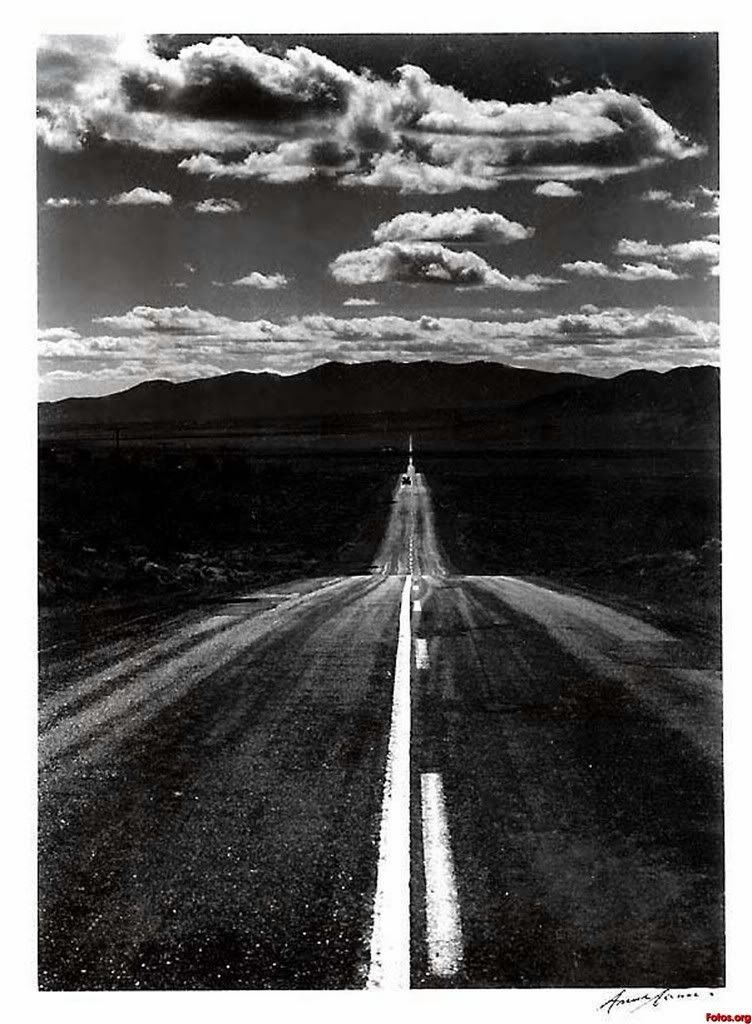
Vantage Point--
This image by Ansel Adams shows a clear vantage point. The "key to flatness" here shows that this picture solves the image. The camera itself is placed low to the ground, making the eye immidiately jump to the lines on the pavement. Upon further notice, we, as the viewers, are getting an idea of continuance because of the vantage point we are given. If the camera had been any higher, we would not have the sense of being right there on the road and following the path it creates. The deatil in the clouds creates an effect also, and had it been different weather conditions, the photograph would not have worked as well. The vantage point here gives us that sense that we are in the photograph, making it difficult to see the photo as flat.
Subscribe to:
Comments (Atom)