In many ways, watching the documentary made me rethink the way photography can function. I’ve always felt that photographs can be one of the strongest tools of social change because of the directness they offer to the viewer of the scene at hand. However, I’ve never let myself believe, as Nachtway has, that photography can end war because it is the “opposite of war.” Watching the film gave me a sense that if photographers are given the ability in a more widespread way to show the public a war scene, they can have a major impact on public consciousness and led people to push for change.
As a viewer, I was intrigued by Nachtway’s quiet, yet actively engaged disposition. While at first, I was a bit repulsed by the way Nachtway took pictures while watching a woman sob, after watching more of the piece, I came to understand not only his photographs, but also his philosophy better. He sees photography as a means of saying “this is what’s happening” and “I am part of this.” It is through the complicity of people involved in his photographs that Nachtway is able show the rest of the word what’s going on around them in a way that the mainstream media does not want them to see. And it is through pushing himself to take photographs that might be uncomfortable to take that he is able to make his viewers uncomfortable in turn and much less likely to look the other way.
Overall, I got a sense that Nachtway leads a graceful and honest life in a profession that often leads many to lack compassion in pursuit of getting a great, sellable shot of tragedy. I believed him when he said “through photography, I’ve discovered the world and myself” because you can see in his works that photography has led him to explore and challenge himself mentally, emotionally and physically. His photographs are not just mere things, they are embodiments of the stories going on around him in the world and his responses to them.
What I was left with were Nachtway’s words that “it’s difficult to give people something that is not an escape from reality, but more of an immersion into reality.” As a whole, western civilization is moving more and more towards the pursuit of things, status, and image and less towards looking at the deeper issues around us. Its much easier to look at an ad for shoes than it is of the face of a starving child and, in many ways, we are left feeling helpless when we are constantly being fed that shock us. Still, I think Nachtway’s aim is a good one. He believes that the public deserves more and he aims to give them it. He struggles to bring to light what so often is hidden. Ultimately, he questions what he is doing to help and he risks his life not to capture a shot, but to capture a story.
Tuesday, March 24, 2009

Wednesday, March 11, 2009
Saturday, March 7, 2009
Vantage Point
 Jeff Rauch
Much like the image Knoxville, Tennessee, 1971, by Lee Frielander in the Stephen Shore book, the vantage point of this photograph creates a certain unique visual illusion. The monocular vision of the camera makes it seem as though the buildings in the background are resting on top of the street sign in the foreground, when they are actually in two completely different spatial planes as this scene would be seen by a person's binocular vision. If the photographer were to have taken the picture just a bit above, below, to the right, or to the left of this particular vantage point, this photograph would not have the same visual effect as it does, and perhaps have a completely different meaning as a result.
Thursday, March 5, 2009

The Depictive Level
Vantage point solves the picture, rather than composing it, by allowing the viewer to view a three dimensional space in the form of a two-dimensional image based upon flatness. Vantage point dictates what the viewer sees within the photograph, including any spatial relationships between objects depicted within it. However, vantage point does not compose the space, nor the relationships between objects. Vantage point does not move the objects around to create the image. Rather, it uses the relationships that are already present to convey a certain image. For example, in this photograph, the pillars appear closer together the deeper into the picture your eye travels. However, in the physical world, the pillars are most likely the same distance from each other. Using the vantage point chosen, the pillars appear to recede into the background, narrowing the space as things get smaller. The pillars do not actually get smaller or closer together, but rather the vantage point is able to “solve” the picture by demonstrating the spatial relationships one might observe in a flattened image of the scene. The “smaller” pillars are simply farther away from the camera than the “larger” ones closer to the front of the scene. In this way, vantage point works with flatness to create depth in the depicted image, despite the photograph’s flatness as a physical body.
Similarly, spatial hierarchy refers not to the spatial relationship of the images depicted in the photograph, but to the order in which the viewer attends to each aspect of the photograph. Here, focus plays the major role in deciding what the viewer will place his or her attention on first. In this example,
strawberry is highly in focus so the viewer can see the textural detailing on it. Then the viewer pays attention to the cat, with some texture on the fur near the face, but quickly fading out of focus the deeper into the picture the viewer looks. Then the eye travels to notice the reflection of the cat on the shiny surface, probably a table top, which is somewhat in focus near the front paws, but not particularly clear. Spatial hierarchy refers to the order that we pay attention to the different aspects of the photograph. Our eye will travel to focused objects near the center of the photograph before it travels deeper into the depictive space, or toward the edges of the photograph.
Monday, March 2, 2009

This picture has a clear spatial hierarchy. Our attention is immediately captured by the woman in the central foreground. As the viewer explores the photograph more, his or her eyes are led to the tree, then to the house and the bycicle in the left foreground and from there along the street to the back, where he/she eventually wants to discover what is depicted in the background. Even though the bycicle is spatially closer, we only discover it after wandering around in the picture. It also indicates a continuation of the street into the other direction.
Spatial hierarchy and Vantage Point
This picture is "solved" by the choice of the Vantage Point .
.
By posing the camera in the chosen position, the photographer determines his or her focus intentionally on the word "vantage" but also shows its surroundings. So, the photographer clearly points out the subject that he/she decided to grant the highest importance to, but he/she also gives enough information for the viewer to place the subject into a logical context. This is a way to not letting the subject stand isolated but also not presenting it exclusively.
 .
.By posing the camera in the chosen position, the photographer determines his or her focus intentionally on the word "vantage" but also shows its surroundings. So, the photographer clearly points out the subject that he/she decided to grant the highest importance to, but he/she also gives enough information for the viewer to place the subject into a logical context. This is a way to not letting the subject stand isolated but also not presenting it exclusively.
"Spatial Hierarchy"

Spatial Hierarchy means the way in which the plane of a photograph is organized through the vantage point and/or "plane of focus". Space functions as the organizer of the content/subjects of the picture. It also gives the photographer the ability to decide depth of field and manipulate the plane of focus.
This photograph is front cover of a book of photos of El Salvador during and after the civil war, by Larry Towell. The kid on the left is wearing stars as to celebrate the "Day of The Dead" while the kid on the right roles a tire, taking it to the shop where he works an adults job.
Sunday, March 1, 2009
"Solving more than composing"

The way I interpret the quote "Vantage point is the key to flatness--it can solve the picture more than compose one" is in the sense that the viewpoint of the image can give us a sense of what the author's perspective was at the time he/she took the photograph of the image in front of him/her. The way the content of the photograph is structured creates a relationship between the "things" in the photograph which provoke a certain reaction.
Thursday, February 26, 2009
Spatial hierarchy/vantage point
 The spatial hierarchy in "The Performers" can be seen row by row. The main focus is on the musicians in the front row. There is activity in each row back--parents and grandparents taking pictures, videos, and looking bored, but none of this is the central purpose of the picture. The audience creates space.
Vantage Point is key in James Horan's photograph of this man and a little girl. The man's hands make the picture--they are in your face, creating an obvious focal point. If they were in any other position, your eye might be drawn to the little girl in the middle ground, and less so to the man in the foreground. Because the camera is angled above the man, and you can't see his arms, his hands become super big and powerful.
Wednesday, February 25, 2009
Spatial Hierarchy--

This image shows a clear spatial hierarchy. The photographer shows a foreground, which your eyes look at instantly, the street signs, a middle ground--the street light, the building behind it, and a background--which is the sky. While all three are sharp, the sharpest appears in the foreground and is eye-catching. The vantage point in the photograph also makes the image work really well in showing the hierarchy, if it had been different you never would have gotten the same serenity as was in this photograph.

Vantage Point--
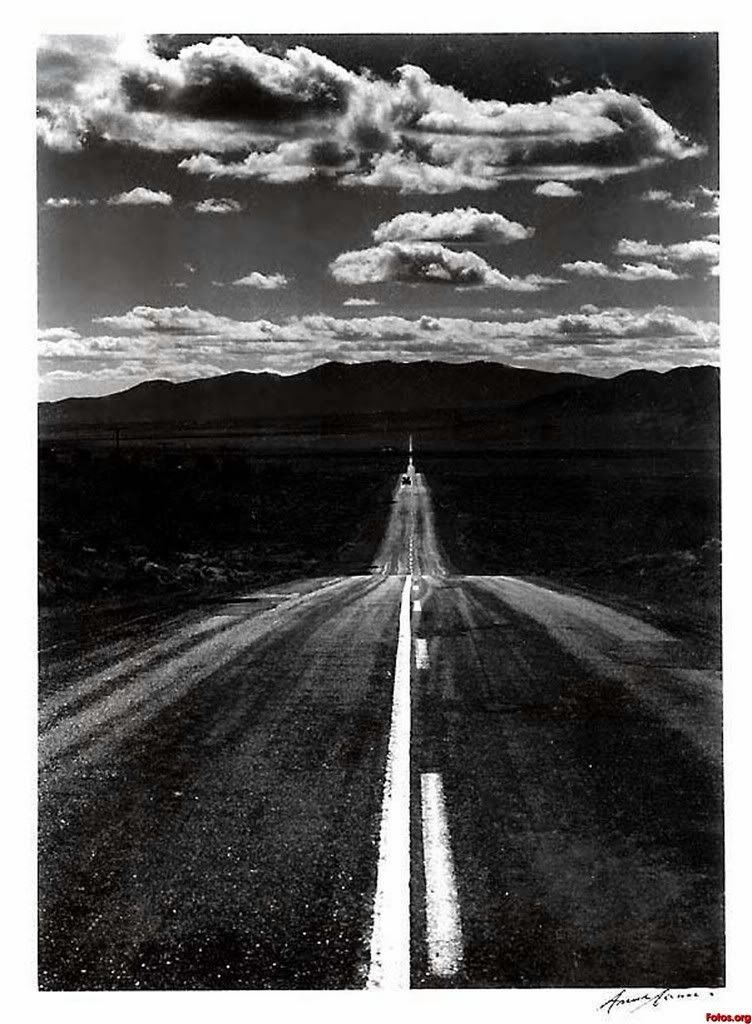
This image by Ansel Adams shows a clear vantage point. The "key to flatness" here shows that this picture solves the image. The camera itself is placed low to the ground, making the eye immidiately jump to the lines on the pavement. Upon further notice, we, as the viewers, are getting an idea of continuance because of the vantage point we are given. If the camera had been any higher, we would not have the sense of being right there on the road and following the path it creates. The deatil in the clouds creates an effect also, and had it been different weather conditions, the photograph would not have worked as well. The vantage point here gives us that sense that we are in the photograph, making it difficult to see the photo as flat.

This image shows a clear spatial hierarchy. The photographer shows a foreground, which your eyes look at instantly, the street signs, a middle ground--the street light, the building behind it, and a background--which is the sky. While all three are sharp, the sharpest appears in the foreground and is eye-catching. The vantage point in the photograph also makes the image work really well in showing the hierarchy, if it had been different you never would have gotten the same serenity as was in this photograph.
Vantage Point--
This image by Ansel Adams shows a clear vantage point. The "key to flatness" here shows that this picture solves the image. The camera itself is placed low to the ground, making the eye immidiately jump to the lines on the pavement. Upon further notice, we, as the viewers, are getting an idea of continuance because of the vantage point we are given. If the camera had been any higher, we would not have the sense of being right there on the road and following the path it creates. The deatil in the clouds creates an effect also, and had it been different weather conditions, the photograph would not have worked as well. The vantage point here gives us that sense that we are in the photograph, making it difficult to see the photo as flat.
The Depicitive Level
 Mary Ellen Mark – Amanda and Her Cousin, Amy Valdese, North California
Spatial hierarchy refers to the ranking of emphasis based on focus in a photograph. Typically, the photograph's subject will be most in focus while the rest of the depicted content hold different levels of sharpness. The observer's attention immediately goes toward what's most in focus, though there may still be important content in the photograph. In Mark's photograph, the girl standing is presumably the subject based on the fact that she's on the highest plane of focus. Everything about her is sharp, from her fingernails to her earrings to the ash on her cigarette. You can even tell that she's wearing eyeliner. The other girl, though less sharp and in focus, contributes heavily to the composition and interpretative meaning of the photograph, but probably isn't the subject.
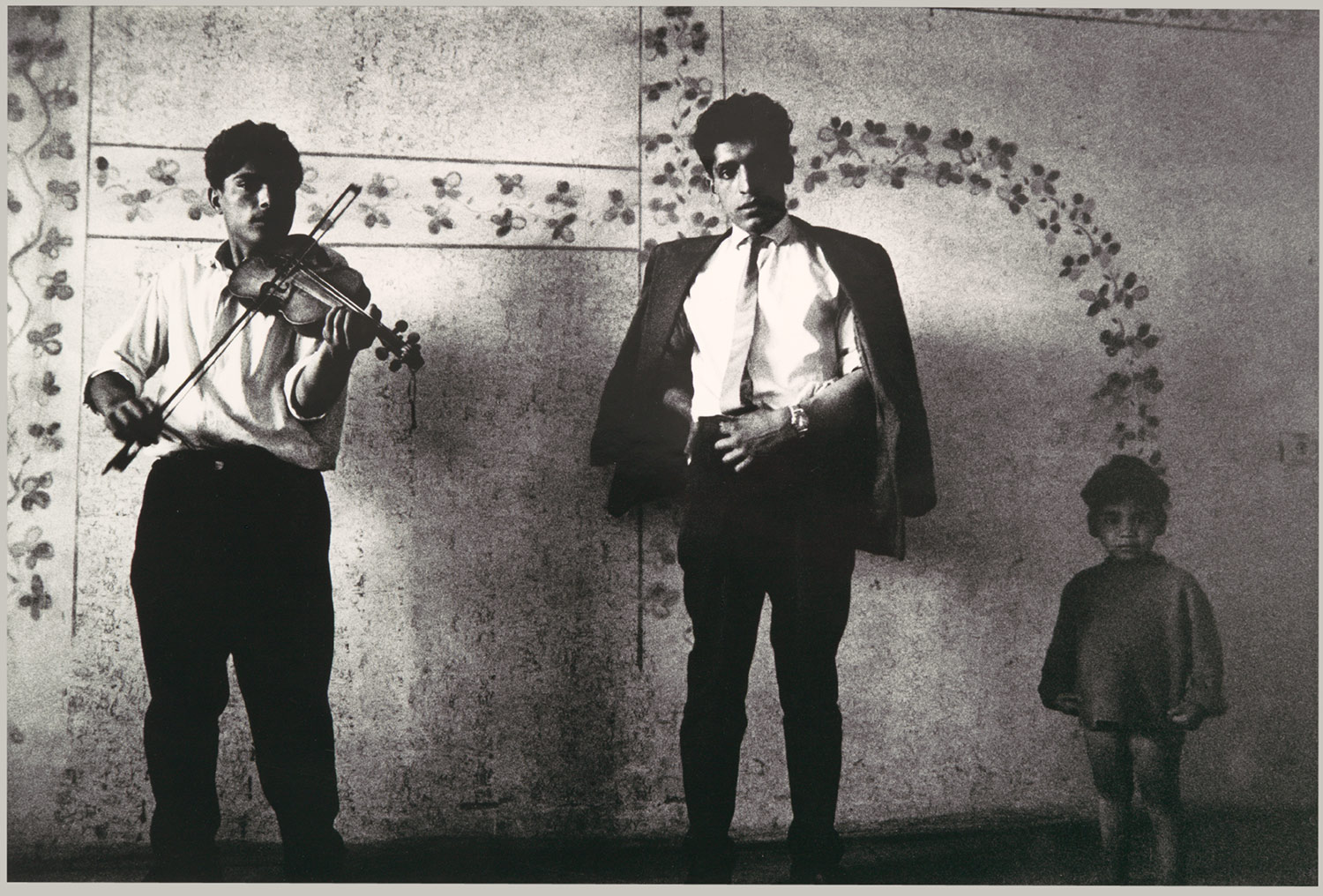 Josef Koudelka – Kendice
"Vantage point is the key to Flatness – it can solve the picture more than compose one."
Instead of composing a photograph by constructing an artificial scene, one can alter his or her vantage point to find that 'perfect moment,' though in terms of visual relationships and not time. In Koudelka's piece, he found a vantage point that highlights the wall decoration as well as his subjects. The two are placed in a visual juxtaposition that makes the curved line look like it's flowing from the man's head into the head of the little boy, or the other way around.
vantage point and spatial hierarchy

I believe that this photo is a good example of vantage point being the "key to flatness"--although there is obviously a subject of the photo (the suited man in the foreground), we clearly get to see the people in the background as well, their actions making a straight line across the middle. One second before or after, and this photo might not have worked as well. We also get to see a glimpse of what the suited man might be seeing--his "vantage point."

The shallow depth of field of this photo definitely separates the the photo's subject from it's contents, and therefore outlines the spatial hierarchy present. The sharpness of the glasses in the foreground (the photo's"plane of focus") draws us to them, and only at a second look can we separate the chairs from the table and the shadowy figure of the person in the background.
engaging movement
 I see both Vantage point and spatial hierarchy as crucial components of this image. Because of the specific vantage point from which this photograph is taken, the viewer's gaze is able to travel along with the flow of the water. If taken from any other vantage point, the water may have a completely different feel. Furthermore, the way the photographer has positioned him/herself in the landscape lends the spatial hierarchy of the image to be both complex and engaging. There is a ton of movement within this photograph, and the space is organized in such a way that the viewer cannot help but move his/her focus along with the stream of the water.


Tuesday, February 24, 2009
Spatial Heirarchy

This image has an obvious foreground, mid, and background organization--showcasing its spatial hierarchy). The photographer probably captured the space in this picture to purposely depict the natural organization of these formations from the specific vantage point her or she took. Foreground (cliff/boulder to immediate left), Mid (grassy knoll/ closest hill), Background (water/distant landscape/sky).
Vantage Point

This picture is titled "Phantom, Cape Disappointment, Oregon, 2006" and was taken of this man (a fellow photographer) who walks up the spiraled stair case of the North Head Lighthouse. In his blog, the photographer writes: "Using the image stabilization feature of my camera, I was able to hand-hold this image at one full second in the dark stairwell of the lighthouse as a fellow photographer, unaware of my presence, came walking up the steps. There is some minor blurring of the stairs and wall, but it supports the central point of the image: movement in time. When my fellow photographer saw me, he stopped in his tracks and looked up, blurring only his face. He graciously apologized for “ruining” my picture. Yet he gave me exactly what I wanted. A phantom. It is the face and the shadow coming out of the body that gives up the ghost here – a function of my high vantage point."
The photographer purposely did not control his subject in a way that "composed" an exact, still picture relative to time. Rather, due to the movement (namely of the subject's face), and high vantage point, a phantom picture resulted, and the photographer depictivley "solves" the message communicated in this image--accepting the results of the random movement of his unknowing subject.

Keeping with the Sally Mann theme, looking at her various works reveals how much spatial hierarchy is used to create different meanings in her work. In this first image, we get very little spatial hierarchy. We as viewers only see the subject and the background. In this image, Mann is able to use limited spatial hierarchy in order to startle us because we are forced, whether we want to or not, to look at the subject’s face.

In the second photograph, there is more depth of field. The viewer sees the shoes and toy shopping cart as most immediate images. Still, the children, who are in the center, have the greatest focus spatially. By having the subjects further from the camera, Mann is able to allow us to see more of their word and to draw our attention to many different objects that form a world we create around the photograph. The way the floor boards line bottom of the picture and the contrast of the blurry sky versus the sharpness of the objects closest to the camera all combine to create a sense of what the picture is about.

This image conveys to me just how much vantage point controls the meaning and mood of a photograph. In Sally Mann’s photograph, the fact that the camera is pointed down on the subject adds and even creates the meaning. In many ways, the vantage point unites with the worn down horse figure and the hazy expression on the child’s face. The vantage point seems to pressure if not force us to make some kind of judgment of the subject’s childhood. Her nudity, combined with the fragile yet natural way she covers herself seems to make the meaning of the piece much more apparent when analyzed in connection with the vantage point.
Sunday, February 22, 2009


Both of these pictures have different spacial hierarchy. The first one has a shallow depth of field, so we draw our attention to the little girl and the birds, and don't pay much attention to what is in the background. This isolates the girl from everything else . The second picture has a less hierarchical emphasis due to the increase in depth of field. This picture still has many levels though, and our attention diminishes as we look past the boats ( and the sharpness drops off). This plane of focus grabs our attention to the boats/


Wednesday, February 18, 2009
Vince's Reflection: Art Event in Boyden Gallery--> Panel Discussion on Color
An interesting panel discussion in Boyden Gallery was held on February 4th. The panel comprised of six professional academics (or scholars) who where asked to provide an intellectual discourse (in the form of informal discussion—not debate) on the topic of color. The discussion was mediated by an art/art history professor and included faculty members from the departments of psychology, archeology, physics, and religious studies/philosophy (specializing in phenomenology). The discussion also included an artist whose painting was featured in the gallery.
The main topic of discussion provoked the question: ‘how do we come to understand art and what it means to different perspectives?’ This was accomplished through discourse surrounding concepts of color and spatial influence.
I purposely attended this art event because I was excited to here interdisciplinary discussion on this perceptually abstract topic. It's not often that we, as students, get to here faculty discuss abstractions. It turned out that each of the individual scholars contributing to the discussion added what I had originally expected them to contribute: the psychologist wondered how we, as human, find an importance in being able to both create and decipher color variations, and the physicist was interested in how specific wave lengths of pigments enter the eye (atmospheric optics) and was also intrigued by the plethora of wavelengths ‘unseeable’ to the human eye. The archeologist (Prof. Julie King) provided the most practical or tangible understanding and use of color out of all of the panelists. She said that in her field, it is incredibly important in understanding the date/time/setting of a given archeological site by discerning the various colors of dirt strata. She referred to a cathedral she recently visited to highlight this notion.
Less tangible, in a sense, were the physicist and philosopher who spoke of various concepts of color using abstract and often discursive language. At times the panel drifted into highly abstract arenas of understanding how color is created and perceived—this was entertaining for me to hear because of its incredible lack of accessibility at certain points, but was also interesting because what was being discussed ultimately achieved intellectual agreement across the panel—perhaps an indication of the inherently cohesive liberal and artistic college community.
In all, I enjoyed the discussion because it posed many hypothetical answers to questions (i.e. why/how does the human perspective determine experience?) which, in turn, posed/created even more, perhaps unanswerable, questions (such as, “where does the experience of color come from?” and “how does our biology/coordination of movement effect our experience with pigments?”)
The discussion successfully satisfied my interest in hearing a bunch of egg-headed intellectuals throw big words and abstract ideas into the cauldron of scholarly discourse focused upon color perception. I would have liked to see prof. Curt Raney from the sociology department add his spin, however. His perspective could have added profound amounts of logic to the already ‘rational-ish’ discussion.
The main topic of discussion provoked the question: ‘how do we come to understand art and what it means to different perspectives?’ This was accomplished through discourse surrounding concepts of color and spatial influence.
I purposely attended this art event because I was excited to here interdisciplinary discussion on this perceptually abstract topic. It's not often that we, as students, get to here faculty discuss abstractions. It turned out that each of the individual scholars contributing to the discussion added what I had originally expected them to contribute: the psychologist wondered how we, as human, find an importance in being able to both create and decipher color variations, and the physicist was interested in how specific wave lengths of pigments enter the eye (atmospheric optics) and was also intrigued by the plethora of wavelengths ‘unseeable’ to the human eye. The archeologist (Prof. Julie King) provided the most practical or tangible understanding and use of color out of all of the panelists. She said that in her field, it is incredibly important in understanding the date/time/setting of a given archeological site by discerning the various colors of dirt strata. She referred to a cathedral she recently visited to highlight this notion.
Less tangible, in a sense, were the physicist and philosopher who spoke of various concepts of color using abstract and often discursive language. At times the panel drifted into highly abstract arenas of understanding how color is created and perceived—this was entertaining for me to hear because of its incredible lack of accessibility at certain points, but was also interesting because what was being discussed ultimately achieved intellectual agreement across the panel—perhaps an indication of the inherently cohesive liberal and artistic college community.
In all, I enjoyed the discussion because it posed many hypothetical answers to questions (i.e. why/how does the human perspective determine experience?) which, in turn, posed/created even more, perhaps unanswerable, questions (such as, “where does the experience of color come from?” and “how does our biology/coordination of movement effect our experience with pigments?”)
The discussion successfully satisfied my interest in hearing a bunch of egg-headed intellectuals throw big words and abstract ideas into the cauldron of scholarly discourse focused upon color perception. I would have liked to see prof. Curt Raney from the sociology department add his spin, however. His perspective could have added profound amounts of logic to the already ‘rational-ish’ discussion.
Subscribe to:
Comments (Atom)