Tuesday, March 31, 2009

Artist Talk: March 30th

On March 30th I attended the artist talk entitled “Self Portrait,” which featured Richard Emery Nicholson. Mr. Nicholson began his discussion by stating that he has been highly influenced by William Carlos Williams and Albert Camus. At first I thought it was a bit unconventional for him to cite writers and not artists as his greatest influences, but as the talk went on, I began realizing more and more that Mr. Nicholson draws from all kinds of places for his work, such as his childhood to buildings he’s been fascinated with to verses that have inspired him.

While in some ways I wish Mr. Nicholson had addressed this concept of the “Self-Portrait” directly, by listening to him speak about his art up until this point in his life, I got a sense that every piece he has created has been some reflection of himself and the point in his life he was in. When he was drafted, for instance, Mr. Nicholson documented his life with painting and photography. He created pieces such as “Shooting Gallery Landscape” in Cambodia. When pursuing his MFA, Mr. Nicholson worked on “Variations on the Shaker Theme.” At different periods in his life he’s combined painting with ceramics, which reminds him of building a house by hand with his father when he was little. All in all, Mr. Nicholson embodies this idea that to be an artist, one must take and give. By being an active participant in his art and allowing it to be shaped and create by his experiences, Mr. Nicholson offers a reflection of himself in his work.

The artist concluded his talk citing Camus’ “Literary and Critical Essays,” by stating, “a man’s work is nothing but this slow trek to redsicover, through the detours of art, those two or three great and simple image in whose presence his heart first opened.” Camus captures this sense of searching through the means of art for one’s self and creating pieces that not only reflect one’s self but essentially capture him/her on the canvas itself. From the talk, I was left with the sense that for this is Mr. Nicholson’s goal—to put himself on the canvas. As for me, listening to the talk reinforced the idea that in whatever kind of art I create, I should leave traces of myself on the canvas or the page, because if art doesn’t speak to who you are, what is it really?

Monday, March 30, 2009

"War Photographer"

The documentary about James Nachtwey was unlike anything I had ever seen before.  The images themselves were vaguely familiar, but it was the method of taking the pictures that was most striking.  The single most effective aspect of the documentary was the employment of a small video camera attached to the top of Nachtwey's actual film camera.  Even after seeing his photographs printed, I don't think you could ever fully realize how close he his to his subjects, until you are a passenger on top of his camera.

Within in the documentary, there was a scene of a mother who was burying her son.  As family members were preventing her from falling to the ground, James was literally inches from her face taking pictures.  I kind of disagreed with this series of events.  Yes, he has a job to do but at what point is he crossing the line?  He later expressed that he forms a relationship with his subjects, and that they want him to be there, but I feel that if I was this mourning mother I would not want a camera flashing before face in one of my weakest moments.  

I think he takes on a unique niche in war photography as he is not only dealing with Americans.  I feel like in todays war-torn world, most American media is focused on America, and how the war is effecting our troops.  I think more work similar to his needs to be more forefront in our society, compared to the propaganda that litters our news today.  Additionally, I thought it was crucial of him to explain that he was shooting people after help had arrived.  With out his explanation, one could easily assume (as I did) that he is photographing helpless, dying people, instead of providing them help and food (specifically regarding famine victims.)  I think that his work is unique also due to the artistic nature of the filming and developing process.  The documentary shows that he is not merely documenting what he sees, but spends a painstaking amount of time getting the perfect shot, and the perfect exposure.

All in all, I thought the documentary was very informative and opened my eyes to the life of a war photographer, as well as the lives of war victims.  I'm actually planning to use some of his images for inspiration in my Drawing Studio class.

Sunday, March 29, 2009

War Photographer

I made a couple of observations while watching this documentary--First of all, since this film was a documentary, filmmakers were able to do to Nachtwey what he does to his subjects.  They got in his face, and took a walk in his shoes, getting a look at what he sees on a "typical" photoshoot.  I found it shocking how unafraid and comfortable he was with pushing the limits--especially in terms of his grieving and obviously pained subjects.  I think as consumers of photography, we forget about the process.  We look at an image and feel as if we are in it while still being separate from it; we know that a photographer was involved in the creation of the image, but we typically don't see that person IN that moment, capturing it.  Watching Nachtwey undergo the process--coughing in the sulfur mines, smelling the stench of corpses, narrowly escaping bombs and bullets, gave each image so much more meaning and weight.  This documentary helped me take a step back and respect field photography as a process.

Secondly,  I found it interesting the relationship Nachtwey had with his subjects.  He described his subjects' understanding of his intent-- to document and show the world their suffering.  I found it hard for me to watch a woman bawling her eyes out over her son's death, and Nachtwey taking roll after roll of film in this woman's face.  I know they were okay with this, but like I said, it was hard for me to watch.

Overall,  I loved getting an in depth look at the life of a photographer--especially one whose life is so dangerous.

Saturday, March 28, 2009

War Photographer

This was an amazing documentary in my opinion. It evoked a number of emotions for me as the viewer and gave me insight into the world of war photography, something I had not known very little about beyond various images that I've seen from the news or from old publications of earlier wars. Images like those did not strike me as much as Nachtwey's photographs did. In seeing and hearing Nachtwey's story of his career and life as a war photographer, I felt compassion, anger, fear, and sadness, among other things, for the people in his photographs and the turmoil and struggles they faced in such conflicted situations.

What struck me about Nachtwey as a photographer was his ability to jump right into the middle of violent situations, putting himself in danger of being physically harmed or even killed, and remain completely calm and in control of himself mentally in the midst of chaos. Other war photographers put more importance on keeping themselves out of physical danger by shooting from afar, atop of a building or in some other fairly protected area, and end up with images that document the event from a viewer's standpoint; however, Nachtwey's photographs show not only a documentation of the situation, but a completely personal interaction with the people involved and a direct engagement of the photographer as an integral part of the situation with the environment. To me, this is something that goes far beyond just photographing a war. Nachtwey makes himself part of the action, and thus ends up with dramatic and stunning photographs that make the viewer feel what he might have felt at the particular moments when he took the images.

Another aspect of Nachtwey's photography that intrigued me was his understanding of what it takes to be able to photograph people at their most emotionally extreme moments in such desperate times. He spoke of a certain calm and mature attitude that he must possess as a photographer in seeking to photograph people that will let them know that he has respect for them and the things they are going through. When he photographed the family of the man who had lost his arm and leg in a train accident, he didn't act just as a photographer who wanted to get amazing images for his own benefit, but rather he introduced himself and spent a good amount of time with them, photographing their ways of life living in on scrap materials in a ditch in between two train tracks. He developed a certain understanding with them that his photographs would give them a chance to be seen and heard in the world. All of Nachtwey's work seemed to play out in this manner. His subjects knew they would have a chance to tell their story through his photographs, in such a way that might not otherwise be possible to do in some situations.

This documentary inspired me to think a lot about how photography is not just a way to document what you see, but it is a medium through which a photographer can communicate how they relate themselves to the world and emotions they feel from their experiences.

Tuesday, March 24, 2009

"war photographer" response

I took a journalism course sophomore year, and one assignment asked us to cover some aspect of the war in Iraq. I decided to write on Americans' ability to desensitize themselves from the harsh realities of war, and watching Jim Nachtwey's experiences reminded me of this project. It is so easy to stay away from the news and ignore what's going on in the world when it doesn't directly affect you. Jim's photos puts you right there in the moment. I was really touched not only by the rawness of his photos, but the undeniable connections he made with his subjects. I'm sure like most of the class I was shocked by Jim's "lack of censor"--he definitely had no problem getting up close and personal with those he photographed--but what struck me the most was that they actually accepted him and allowed him to be involved in their personal narratives. Jim's striving to gain the trust of his subjects allows us a complete uncensored view of these people's lives; something I believe might be necessary in order for us to "wake up" and realize that these things actually happen in the our world, and that we to address it.

I was impressed by Jim's boldness; he definitely put himself in immense danger in order to get some of those photos. I'll admit that at times I thought that he was kinda crazy, but I realized that it was out of extreme passion that he risked his life so many times. He had an agenda in capturing these moments and sharing them with the world, he wants people to actually "resensitize" themselves with our world, a call to action. Jim's commentary on mass media's obssession with fashion and celebrities struck me as well; I realized that it is much easier to find an entertainment show than one profiling human suffering around the world. I LOVED the part with Jim wanting to get one of his photos perfect, resulting in the many burning and dodging attempts; it just shows how crucial each part of the photo is in conveying his message. Also, I thought the music in the documentary served as a great backdrop to Jim's journey--the somber notes that accompanied the photos added to its powerful impact.

Despite the "library of suffering in his head" Jim channels his emotions into his work, allowing us to understand the pure humanity on display in his photos. Jim says, "the strength of photography lies in its ability to evoke humanity," and I agree. Using his power to "evoke humanity," Jim Nachtwey's photos serve as a wake up call to society--we all have the ability to inspire change.

Art Show Reflection

I recently went to the Student Art Show in Monty. I went in with an artist's perspective, and tried to apply my knowledge of photography not only to the photographs I saw on display, but also the other forms of art. I know I would not have gone to this show if I was not taking an art class, and I really got a lot out of it, and feel like I understand more about art now.
When I walked in I was automatically drawn to the photographs. The three on the wall to the left as you walked in looked familiar in style to what we have been doing in class. I looked at them not as just a mere observer though, but really thought about the details in the picture. I used the exercise we did with our first project displays in class, and thought about what was shown in the picture, what was not, the lighting, vantage point, aperture, and all the conscious decisions the photographer took in order to produce the final result. The other photographs that stood out to me were the " special places around campus." The thing that I found most intriguing with these photogrpahs was the mounting. They were all mounted on board, but the edges were very rough, and you could even see the wax paper. I knew this could not have been a mistake, or a lazy mounting job because everything in art has a purpose and is symbolic. All of the pictures in this series were mounted the same way. This may be showing the relaxed view the photographer had for these " special places." These are places where someone can be themselved, allow their "rough edges" to show, and not have to impress anyone. The other photographs along the back wall titled " arches of St. Mary's" was also interesting to me. I noticed where the photographer consciously decided to burn and dodge. The arches were very dark in some pictures, and not a lot of detail was shown. I think I would have shown more detail, but I think the darkness pulled the viewer to see beyond the arches, and what was between them. The photographer maybe wanted to allow the viewer to be aware of the different arches around campus, but also the different setting they were in, and the views that were varying. In one picture there was a pickup truck beyond the arches which seemed to take away from the picture. I would have waited until that was gone, but maybe the photographer wanted to show that as a part of St. Mary's , and it could symbolise the work that goes on at St. Mary's, or how things are always moving and changing.
As I walked around the room, I really enjoyed every piece of art. The large colot photograph was very impressive, and I know they must have used a high shutter speed to get such clarity in the moving wings. This photograph made me want to deal with color photographs, and made me wonder the differences in the developing when it comes to black and white and color photography. Some of the art was more abstract than others, and I typically do not understand abstract art. I believe my understanding of photography though has helped me to appreciate all art, and to see the purpse in every decision, stroke, or chisel of wood.
I really enjoyed this exhibit, and it is nice to see art coming from fellow students.
This documentary was very interesting because it was about a subject that I have thought about before, and never understood. I was first interested in war photography when I went to the War Remnants museum in Vietnam. As I walked through the museum, and looked at all the pictures I first was shocked, and realized how much the pictures showed me about the war that I could never understand otherwise. I then was disturbed at the thought of a person, most likely well off, with camera in hand, taking photos of these people in pain, and sometimes, in their last moments of life. Even though I thought the pictures were important, I thought the photographer's potential help was more important. This movie reinforced that idea to an extent, but also broadened my horizons on the subject.
When Nachtwey was taking pictures at the beginning of the movie I was shocked and disturbed at how up close he got to the woman in pain, and how he seemed to be separated from the emotions even though he was right there. He did not seem to truly have empathy or understand what the person was going through. I couldn't help but first wonder if the woman ( and other people in general) knew who the photographer was, and what he was doing. I know if I was in the woman's situation, a photographer in my face would be the last thing I would want. The subject's calmness about the situation came as a shock to me. Throughout the film though, I began to realize that Nachtwey does in fact feel for the people, and channels his emotions in a positive way... through his photography. He does have respect for the people and the situation. In some cases too, as in Indonesia, he introduced himself, and it seemed as though he was accepted in the community, and had a mutual agreement that he cared, but was also there to show others in the world their pain. I liked this agreement, and the idea that seemed to come from it, that he was not better than the subjects in any way, but was trying to help them in his own way. I then realized that his work really does make a difference, and that differnence may make more of an impact than his actions potentially trying to help the people would. His photos not only bring awareness to dire situations, but also, in some cases, help the people being photographed, in the case of the woman donated $20 a month to the family living near the railroad tracks.
A few things stuck out for me in this video. He said that " the way you tell a story defines it to the world." This is true in his work, but photography in general. What we put in the frame, and what is outside of the frame is so important. We have the ability, with our cameras, to tell numerous stories different ways. It seemed as though that Nachtwey belonged in the field he was in, as he seemed to do well in extreme situations, and realzied that his photos were not just mere art, but a way to communicate. I feel that way myself. Even though we think of this class as an art class... it is really about expression, and I feel like we can see ourselves ( and eachother) in our photographs. We, like Nachtwey, should channel our emotion into our work.
After viewing this film I realized that his photos do not allow people to escape from reality, as som art may, but to get deeper into reality. Sometimes people need pictures to believe a situation or to feel compelled to help. Nachtwey said " the people I photograph are more important than myself" , and I think that says a lot. This is not about him, and not about the peopel viewing the photographs ( with their dressy clothes and wine), but about the people in pain. I now know the importance of war photography, even though it is very controversial. I agree fully with his quote " I have been a witness, and these pictures are my testimony. The events I have recorded should not be forgotten and must not be repeated."

Response to documentary

In many ways, watching the documentary made me rethink the way photography can function. I’ve always felt that photographs can be one of the strongest tools of social change because of the directness they offer to the viewer of the scene at hand. However, I’ve never let myself believe, as Nachtway has, that photography can end war because it is the “opposite of war.” Watching the film gave me a sense that if photographers are given the ability in a more widespread way to show the public a war scene, they can have a major impact on public consciousness and led people to push for change.
As a viewer, I was intrigued by Nachtway’s quiet, yet actively engaged disposition. While at first, I was a bit repulsed by the way Nachtway took pictures while watching a woman sob, after watching more of the piece, I came to understand not only his photographs, but also his philosophy better. He sees photography as a means of saying “this is what’s happening” and “I am part of this.” It is through the complicity of people involved in his photographs that Nachtway is able show the rest of the word what’s going on around them in a way that the mainstream media does not want them to see. And it is through pushing himself to take photographs that might be uncomfortable to take that he is able to make his viewers uncomfortable in turn and much less likely to look the other way.
Overall, I got a sense that Nachtway leads a graceful and honest life in a profession that often leads many to lack compassion in pursuit of getting a great, sellable shot of tragedy. I believed him when he said “through photography, I’ve discovered the world and myself” because you can see in his works that photography has led him to explore and challenge himself mentally, emotionally and physically. His photographs are not just mere things, they are embodiments of the stories going on around him in the world and his responses to them.
What I was left with were Nachtway’s words that “it’s difficult to give people something that is not an escape from reality, but more of an immersion into reality.” As a whole, western civilization is moving more and more towards the pursuit of things, status, and image and less towards looking at the deeper issues around us. Its much easier to look at an ad for shoes than it is of the face of a starving child and, in many ways, we are left feeling helpless when we are constantly being fed that shock us. Still, I think Nachtway’s aim is a good one. He believes that the public deserves more and he aims to give them it. He struggles to bring to light what so often is hidden. Ultimately, he questions what he is doing to help and he risks his life not to capture a shot, but to capture a story.

Wednesday, March 11, 2009

Saturday, March 7, 2009

Vantage Point

Jeff Rauch


Much like the image Knoxville, Tennessee, 1971, by Lee Frielander in the Stephen Shore book, the vantage point of this photograph creates a certain unique visual illusion. The monocular vision of the camera makes it seem as though the buildings in the background are resting on top of the street sign in the foreground, when they are actually in two completely different spatial planes as this scene would be seen by a person's binocular vision. If the photographer were to have taken the picture just a bit above, below, to the right, or to the left of this particular vantage point, this photograph would not have the same visual effect as it does, and perhaps have a completely different meaning as a result.

Thursday, March 5, 2009


The Depictive Level


Vantage point solves the picture, rather than composing it, by allowing the viewer to view a three dimensional space in the form of a two-dimensional image based upon flatness. Vantage point dictates what the viewer sees within the photograph, including any spatial relationships between objects depicted within it. However, vantage point does not compose the space, nor the relationships between objects. Vantage point does not move the objects around to create the image. Rather, it uses the relationships that are already present to convey a certain image. For example, in this photograph, the pillars appear closer together the deeper into the picture your eye travels. However, in the physical world, the pillars are most likely the same distance from each other. Using the vantage point chosen, the pillars appear to recede into the background, narrowing the space as things get smaller. The pillars do not actually get smaller or closer together, but rather the vantage point is able to “solve” the picture by demonstrating the spatial relationships one might observe in a flattened image of the scene. The “smaller” pillars are simply farther away from the camera than the “larger” ones closer to the front of the scene. In this way, vantage point works with flatness to create depth in the depicted image, despite the photograph’s flatness as a physical body.

Similarly, spatial hierarchy refers not to the spatial relationship of the images depicted in the photograph, but to the order in which the viewer attends to each aspect of the photograph. Here, focus plays the major role in deciding what the viewer will place his or her attention on first. In this example, the

strawberry is highly in focus so the viewer can see the textural detailing on it. Then the viewer pays attention to the cat, with some texture on the fur near the face, but quickly fading out of focus the deeper into the picture the viewer looks. Then the eye travels to notice the reflection of the cat on the shiny surface, probably a table top, which is somewhat in focus near the front paws, but not particularly clear. Spatial hierarchy refers to the order that we pay attention to the different aspects of the photograph. Our eye will travel to focused objects near the center of the photograph before it travels deeper into the depictive space, or toward the edges of the photograph.

Monday, March 2, 2009


This picture has a clear spatial hierarchy. Our attention is immediately captured by the woman in the central foreground. As the viewer explores the photograph more, his or her eyes are led to the tree, then to the house and the bycicle in the left foreground and from there along the street to the back, where he/she eventually wants to discover what is depicted in the background. Even though the bycicle is spatially closer, we only discover it after wandering around in the picture. It also indicates a continuation of the street into the other direction.

Spatial hierarchy and Vantage Point

This picture is "solved" by the choice of the Vantage Point .
By posing the camera in the chosen position, the photographer determines his or her focus intentionally on the word "vantage" but also shows its surroundings. So, the photographer clearly points out the subject that he/she decided to grant the highest importance to, but he/she also gives enough information for the viewer to place the subject into a logical context. This is a way to not letting the subject stand isolated but also not presenting it exclusively.

"Spatial Hierarchy"


Spatial Hierarchy means the way in which the plane of a photograph is organized through the vantage point and/or "plane of focus". Space functions as the organizer of the content/subjects  of the picture. It also gives the photographer the ability to decide depth of field and manipulate the plane of focus.    

This photograph is front cover of a book of photos of El Salvador during and after the civil war, by Larry Towell. The kid on the left is wearing stars as to celebrate the "Day of The Dead" while the kid on the right roles a tire, taking it to the shop where he works an adults job. 

Sunday, March 1, 2009

"Solving more than composing"


The way I interpret the quote "Vantage point is the key to flatness--it can solve the picture more than compose one" is in the sense that the viewpoint of the image can give us a sense of what the author's perspective was at the time he/she took the photograph of the image in front of him/her. The way the content of the photograph is structured creates a relationship between the "things" in the photograph which provoke a certain reaction.  


Thursday, February 26, 2009

Spatial hierarchy/vantage point

The spatial hierarchy in "The Performers" can be seen row by row.  The main focus is on the musicians in the front row.  There is activity in each row back--parents and grandparents taking pictures, videos, and looking bored, but none of this is the central purpose of the picture.  The audience creates space.


Vantage Point is key in James Horan's photograph of this man and a little girl.  The man's hands make the picture--they are in your face, creating an obvious focal point.  If they were in any other position, your eye might be drawn to the little girl in the middle ground, and less so to the man in the foreground.  Because the camera is angled above the man, and you can't see his arms, his hands become super big and powerful.

Wednesday, February 25, 2009

Spatial Hierarchy--


This image shows a clear spatial hierarchy. The photographer shows a foreground, which your eyes look at instantly, the street signs, a middle ground--the street light, the building behind it, and a background--which is the sky. While all three are sharp, the sharpest appears in the foreground and is eye-catching. The vantage point in the photograph also makes the image work really well in showing the hierarchy, if it had been different you never would have gotten the same serenity as was in this photograph.


Vantage Point--

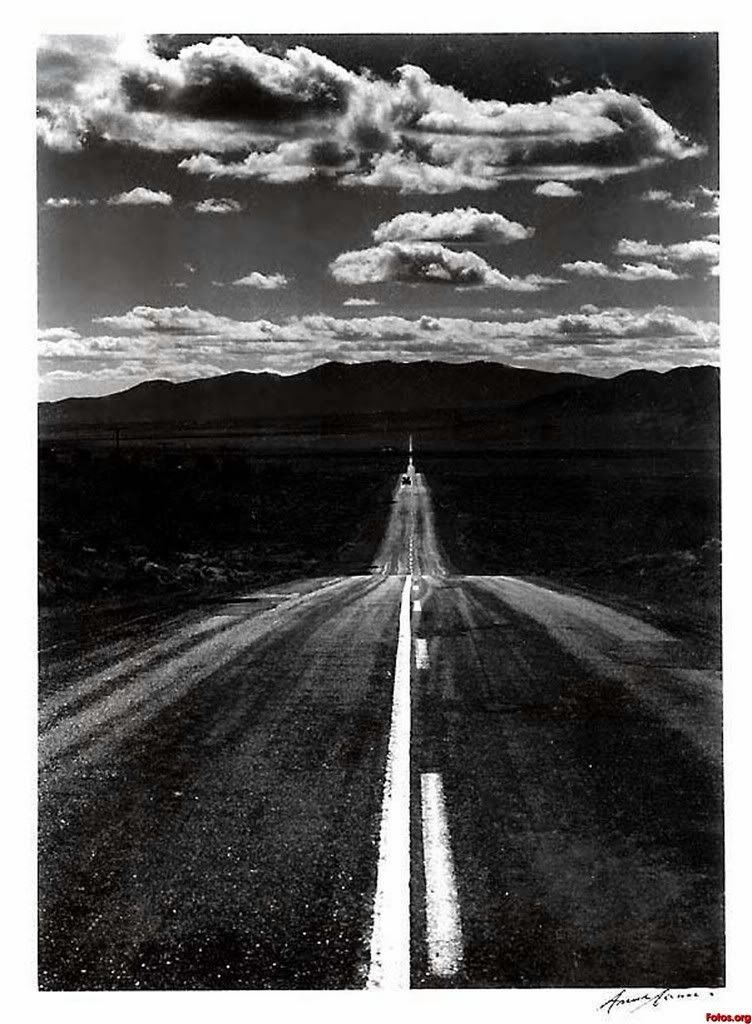
This image by Ansel Adams shows a clear vantage point. The "key to flatness" here shows that this picture solves the image. The camera itself is placed low to the ground, making the eye immidiately jump to the lines on the pavement. Upon further notice, we, as the viewers, are getting an idea of continuance because of the vantage point we are given. If the camera had been any higher, we would not have the sense of being right there on the road and following the path it creates. The deatil in the clouds creates an effect also, and had it been different weather conditions, the photograph would not have worked as well. The vantage point here gives us that sense that we are in the photograph, making it difficult to see the photo as flat.

The Depicitive Level

Mary Ellen Mark – Amanda and Her Cousin, Amy Valdese, North California

Spatial hierarchy refers to the ranking of emphasis based on focus in a photograph. Typically, the photograph's subject will be most in focus while the rest of the depicted content hold different levels of sharpness. The observer's attention immediately goes toward what's most in focus, though there may still be important content in the photograph. In Mark's photograph, the girl standing is presumably the subject based on the fact that she's on the highest plane of focus. Everything about her is sharp, from her fingernails to her earrings to the ash on her cigarette. You can even tell that she's wearing eyeliner. The other girl, though less sharp and in focus, contributes heavily to the composition and interpretative meaning of the photograph, but probably isn't the subject.

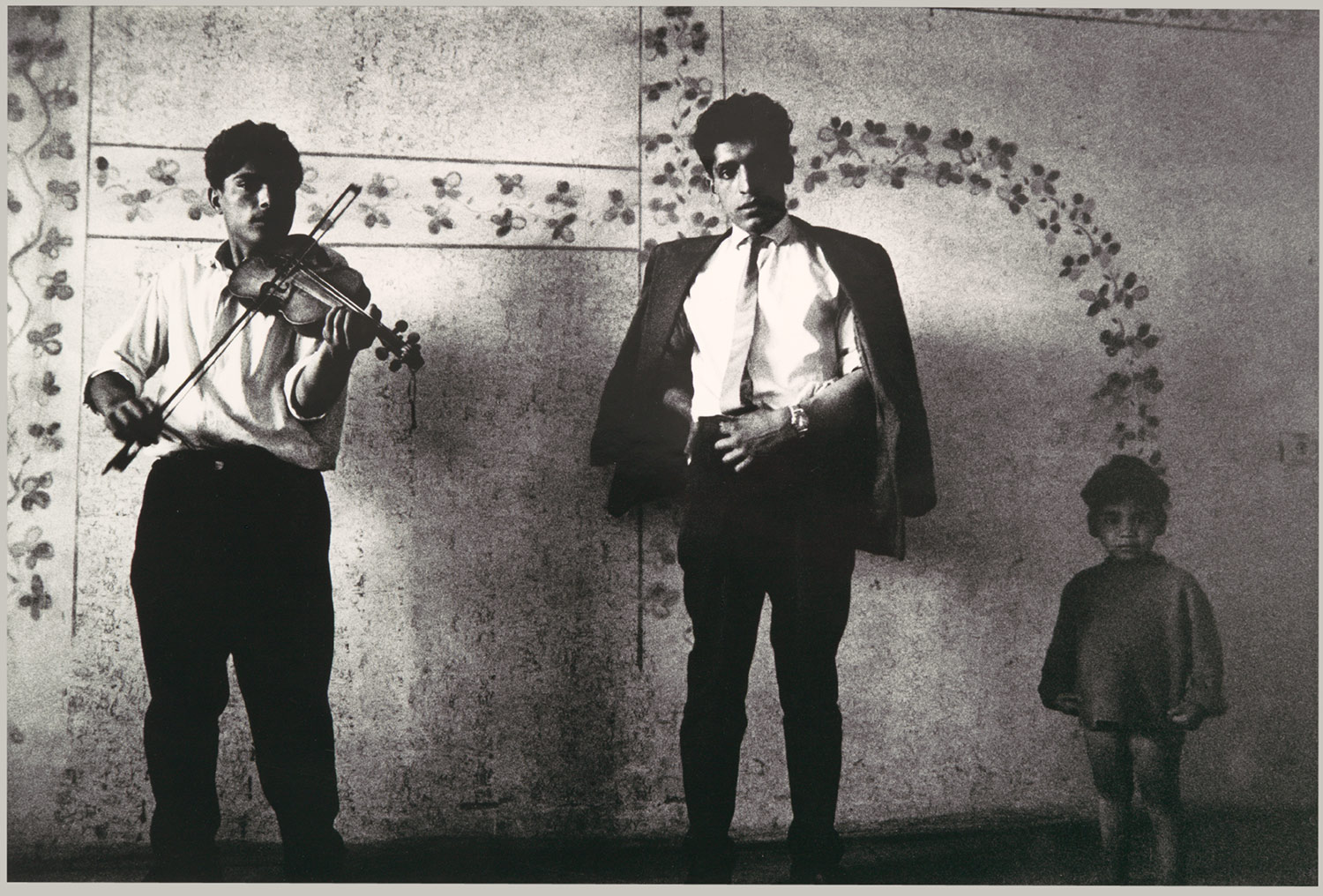
Josef Koudelka – Kendice

"Vantage point is the key to Flatness – it can solve the picture more than compose one."

Instead of composing a photograph by constructing an artificial scene, one can alter his or her vantage point to find that 'perfect moment,' though in terms of visual relationships and not time. In Koudelka's piece, he found a vantage point that highlights the wall decoration as well as his subjects. The two are placed in a visual juxtaposition that makes the curved line look like it's flowing from the man's head into the head of the little boy, or the other way around.

vantage point and spatial hierarchy


I believe that this photo is a good example of vantage point being the "key to flatness"--although there is obviously a subject of the photo (the suited man in the foreground), we clearly get to see the people in the background as well, their actions making a straight line across the middle. One second before or after, and this photo might not have worked as well. We also get to see a glimpse of what the suited man might be seeing--his "vantage point."


The shallow depth of field of this photo definitely separates the the photo's subject from it's contents, and therefore outlines the spatial hierarchy present. The sharpness of the glasses in the foreground (the photo's"plane of focus") draws us to them, and only at a second look can we separate the chairs from the table and the shadowy figure of the person in the background.

engaging movement

I see both Vantage point and spatial hierarchy as crucial components of this image. Because of the specific vantage point from which this photograph is taken, the viewer's gaze is able to travel along with the flow of the water. If taken from any other vantage point, the water may have a completely different feel. Furthermore, the way the photographer has positioned him/herself in the landscape lends the spatial hierarchy of the image to be both complex and engaging. There is a ton of movement within this photograph, and the space is organized in such a way that the viewer cannot help but move his/her focus along with the stream of the water.